

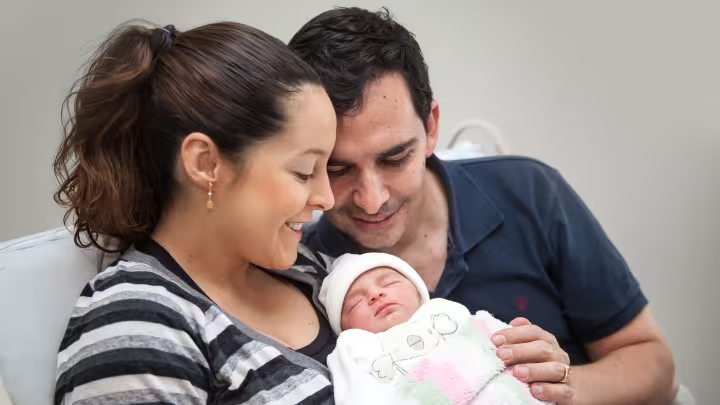




Early‑onset colorectal cancer is increasing. Sinai Health is working to change the odds for patients like Connor.
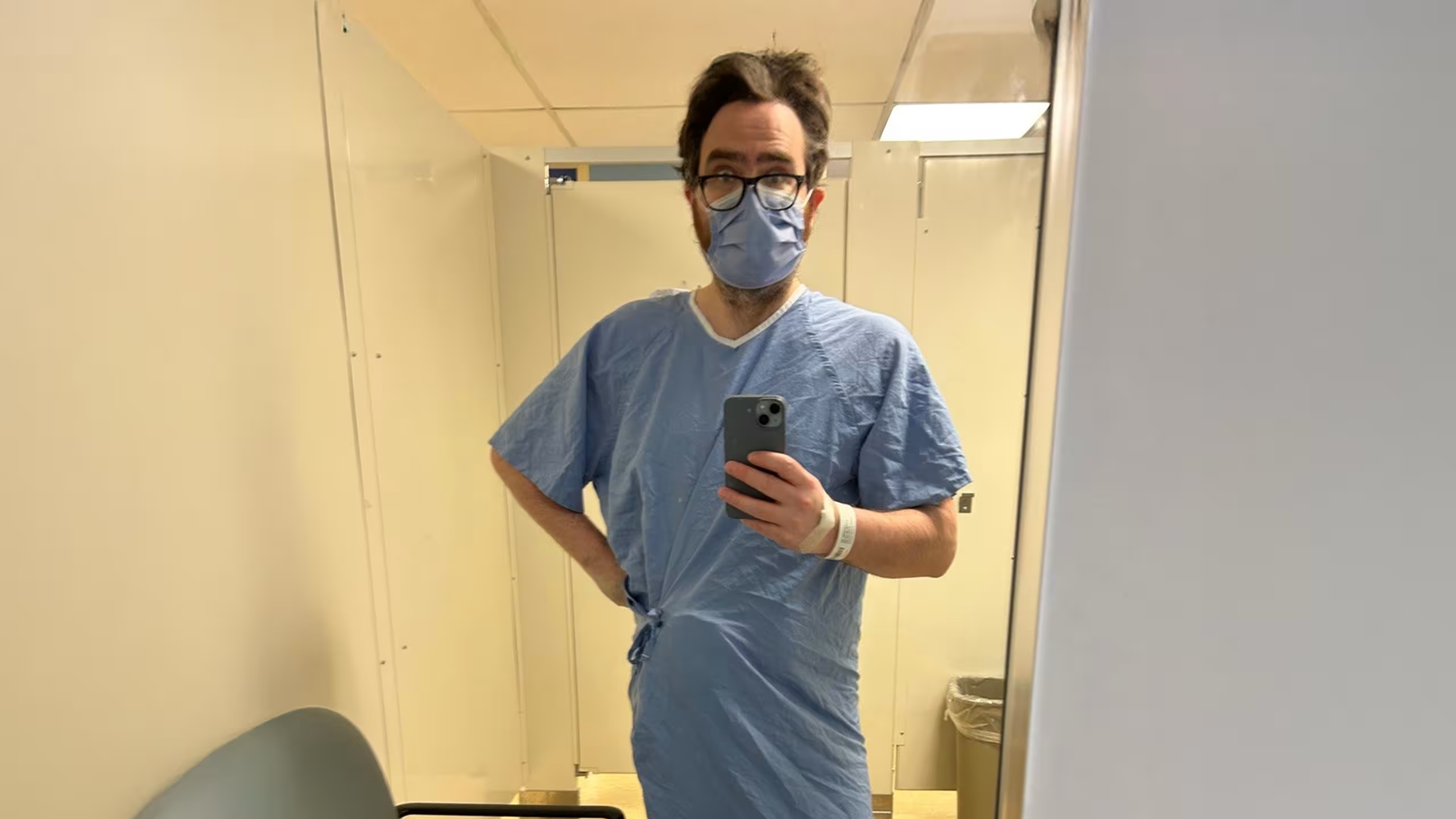
In the summer of 2024, Connor started experiencing persistent lower abdominal pain. He was 42 years old.
“It wasn’t going away,” he recalls. “I went to my family doctor, and at first they thought it was something relatively minor.” When the pain persisted, his doctor ordered further tests, including a colonoscopy. The results were not the 'all clear’ that he was hoping for.
They found a tumour. The doctor delivered the news just minutes after he woke up from the procedure. Tests would later confirm it was cancer.
As someone who has worked as an actor, writer, director and improviser for many years, Connor knows how to find humour and calm in the face of uncertainty. This sense of humour shines through today as he describes those initial moments.
“It’s interesting news to get when you’re still super high from the sedation”, he jokes. “When I look back on that day, it's not a funny thing. But at that moment, I was surprisingly chill about what I was hearing. My wife was there and obviously, without the benefit of heavy sedation, was a little more upset and shocked.”
When the sedation wore off, reality set in. He had a large tumour in his bowel. Further imaging revealed the cancer had already spread to Connor’s liver, lymph nodes and spine. He was diagnosed with stage IV colorectal cancer and referred to Mount Sinai Hospital for his oncology care.
A growing rate of younger adults diagnosed with colon cancer – and why it’s often diagnosed late
Unfortunately, stories like Connor’s are becoming increasingly common.
“We are seeing a significant increase in what we call early‑onset colorectal cancer,” says Dr. Ronald Burkes, a medical oncologist at Sinai Health’s Chris Hugh Sharp Cancer Centre who has been treating cancer patients for more than 40 years. “It’s been about a 50 per cent increase since the early 1990s1. And this isn’t just Canada – it’s a worldwide phenomenon.”
Early‑onset colorectal cancer refers to cases diagnosed before the age of 50. While routine screening in Canada still begins at 50 for people without a family history, most younger patients are diagnosed only after symptoms appear – and by then, the disease is often advanced.
“Somewhere between 60 and 70 per cent of younger patients present with advanced disease2,” Dr. Burkes explains. “Part of the issue is that young people don’t think of cancer as a possibility. Family doctors don’t think of cancer at that age either. Symptoms get attributed to things like IBS, hemorrhoids or stress.”
Research shows that many younger patients see multiple doctors and experience delays of six months or more before receiving a diagnosis3.
This disturbing trend is one of the reasons Dr. Burkes advocates to lower the age of colorectal cancer screenings. It’s also why he’s so proud of the work Sinai Health is doing to advance treatment options for patients like Connor through clinical research.

When research changes the treatment path: A global clinical trial at Sinai Health
Connor began treatment under Dr. Burkes’ care in late 2024. But just days after his first chemotherapy infusion, he was rushed to a hospital in Hamilton with severe abdominal pain. His bowel had perforated – likely caused by the tumour – requiring emergency surgery.
This complication allowed the surgeon to remove the tumour in Connor’s bowel. But, to let his bowel rest and heal, they also had to complete a colostomy – a procedure that creates an opening on the abdomen that lets stool pass into a pouch, which is called a colostomy bag.
“It really drove home how much my body had changed,” he says. “Suddenly I was navigating surgeries, recovery and cancer treatment all at once.”
By January 2025, Conor was back on chemotherapy – and a surprising development meant he had a new treatment option.
As part of his diagnostic work‑up at Mount Sinai, Connor’s cancer underwent molecular testing. The results revealed something unusual: his tumour was HER2‑positive, a mutation more commonly associated with breast cancer and found in fewer than three per cent of colorectal cancers4.
This meant that he was eligible to participate in a global study testing HER2‑targeted therapies in colorectal cancer. This multi-centre trial compares the effectiveness of standard chemotherapy against treatment plans that follow the standard therapy with the addition of an HER2‑targeted therapy. As the largest recruiter for the trial in Canada, Sinai Health is playing a leading role in advancing HER2‑targeted treatments for patients worldwide.
These kinds of trials are essential to pushing the boundaries of cancer treatment. “Clinical trials are how we improve care,” says Dr. Burkes. “You can’t get these drugs funded or widely available unless you do the randomized studies to prove they work better than what we already have.”
For Connor, joining the trial was an easy decision. “It feels good to be part of science,” he says. “Even if it turns out the trial doesn’t help, at least we’ll know. That still moves things forward.”
“The odds don’t define me” – How Connor finds hope in the face of an uncertain future
This trial has an ‘open-label’ format, which means once Connor was accepted, he was able to find out if he’d receive the HER2-targeted therapy or the standard treatment. Or as Connor and his wife, Ashley, jokingly referred to it – business or economy class.
“My wife asked Dr. Burkes, if I was in economy class or business class,” Connor recalls with a smile. “And when he came back, he said, ‘Guess what – you’re in business class.’”
Connor had been randomized to the experimental arm, and he responded exceptionally well to treatment. Scans showed tumours shrinking. Disease in his lymph nodes disappeared entirely.
By late 2025, Connor had reached another milestone: he was eligible for surgery to remove the remaining metastases in his liver.
In February 2026, he underwent a 13‑hour operation. Surgeons removed the liver tumours, addressed another suspicious lesion and reversed his colostomy. Now, the only visible cancer that remains is a small spot on his spine.
While Connor remains measured by the knowledge that his next scan could tell a different story, he’s determined to remain optimistic about his future. He’s also incredibly grateful for the quality of care he received.
“I hear the statistics,” he says. “But I decided early on that those numbers don’t define me. I’m young. I’m otherwise healthy. If the treatment responds, why shouldn’t I beat this? Why shouldn’t I live a very long, healthy life?”
For Connor, a crucial part of maintaining this positive outlook is the care and support he receives from his loved ones.
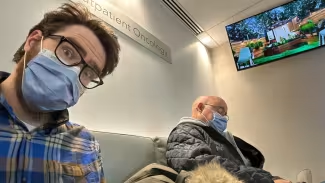
“I would be remiss if I didn’t mention how wonderful it’s been to have my wife along for this ride. She’s been entirely devoted to my care. The support structure I have, including Ashley, including my parents, including her parents – especially my father-in-law Doug – has just been incredible.”
Why building awareness of early on-set colorectal cancer matters
Connor has already seen the ripple effects of his diagnosis. Family members got screened. Friends scheduled colonoscopies. Many started the conversation with their health provider saying, “One of my good friends just got diagnosed with colon cancer, so I'd like a colonoscopy.”
While Connor wouldn’t have wished for this experience, he is happy to be a part of raising awareness of the importance of screenings. He wants more people to understand common symptoms of the disease. “If being the canary in the coal mine means people take symptoms seriously and get checked, then that matters,” he says.
As more young people receive earlier colorectal cancer diagnoses, this kind of awareness can be life-saving. But research breakthroughs are still needed urgently to ensure the system is ready to treat those who receive a colon cancer diagnosis.
“We’ve made incredible advancements in what we can do for colorectal cancer patients. But it’s not enough,” says Dr. Burkes. “We need faster molecular testing, dedicated coordination and biobanking so we can understand the biology behind this epidemic. Anything that helps patients live longer – and live better – is worth fighting for.”
You can help fuel advancements in colon cancer care for patients like Connor
Donor support is an essential part of discovering and testing the next generation of life-saving cancer treatments. When you donate to Sinai Health, you help power the work of physicians like Dr. Burkes – ensuring patients like Connor have access to targeted therapies with the potential to transform their outcomes.
To support Dr. Burkes's work, please select Other from the gift designation dropdown menu and enter ‘Oncology Research Fund- Dr. Ronald Burkes’ as the desired gift designation.
1 Dharwadkar P, Zaki TA, Murphy CC. Colorectal Cancer in Younger Adults. Hematol Oncol Clin North Am. 2022 Jun;36(3):449-470. doi: 10.1016/j.hoc.2022.02.005. Epub 2022 May 13. PMID: 35577711; PMCID: PMC9177054.
2 Ronit I. Yarden, Kim L. Newcomer, Never Too Young Advisory Board, Colorectal CancerAlliance. Young onset colorectal cancer patients are diagnosed with advanced disease after multiple misdiagnoses [abstract]. In: Proceedings of the American Association for Cancer Research Annual Meeting 2019; 2019 Mar 29-Apr 3; Atlanta, GA. Philadelphia (PA): AACR; Cancer Res 2019;79(13 Suppl):Abstract nr 3347. https://doi.org/10.1158/1538-7445.AM2019-3347
3 Castelo M, Sue-Chue-Lam C, Paszat L, Kishibe T, Scheer AS, Hansen BE, et al. (2022) Time to diagnosis and treatment in younger adults with colorectal cancer: A systematic review. PLoS ONE 17(9): e0273396. https://doi.org/10.1371/journal.pone.0273396
4 Benli, Y., Arıkan, H. & Akbulut-Çalışkan, Ö. HER2-targeted therapy in colorectal cancer: a comprehensive review. Clin Transl Oncol 27, 3607–3624 (2025). https://doi.org/10.1007/s12094-025-03887-0
Related news and stories
View all News and Stories


