




Meet the Fellows: Dr. Isaac Chang on inventing a new way to monitor heart health — no wires, no wearables, no effort
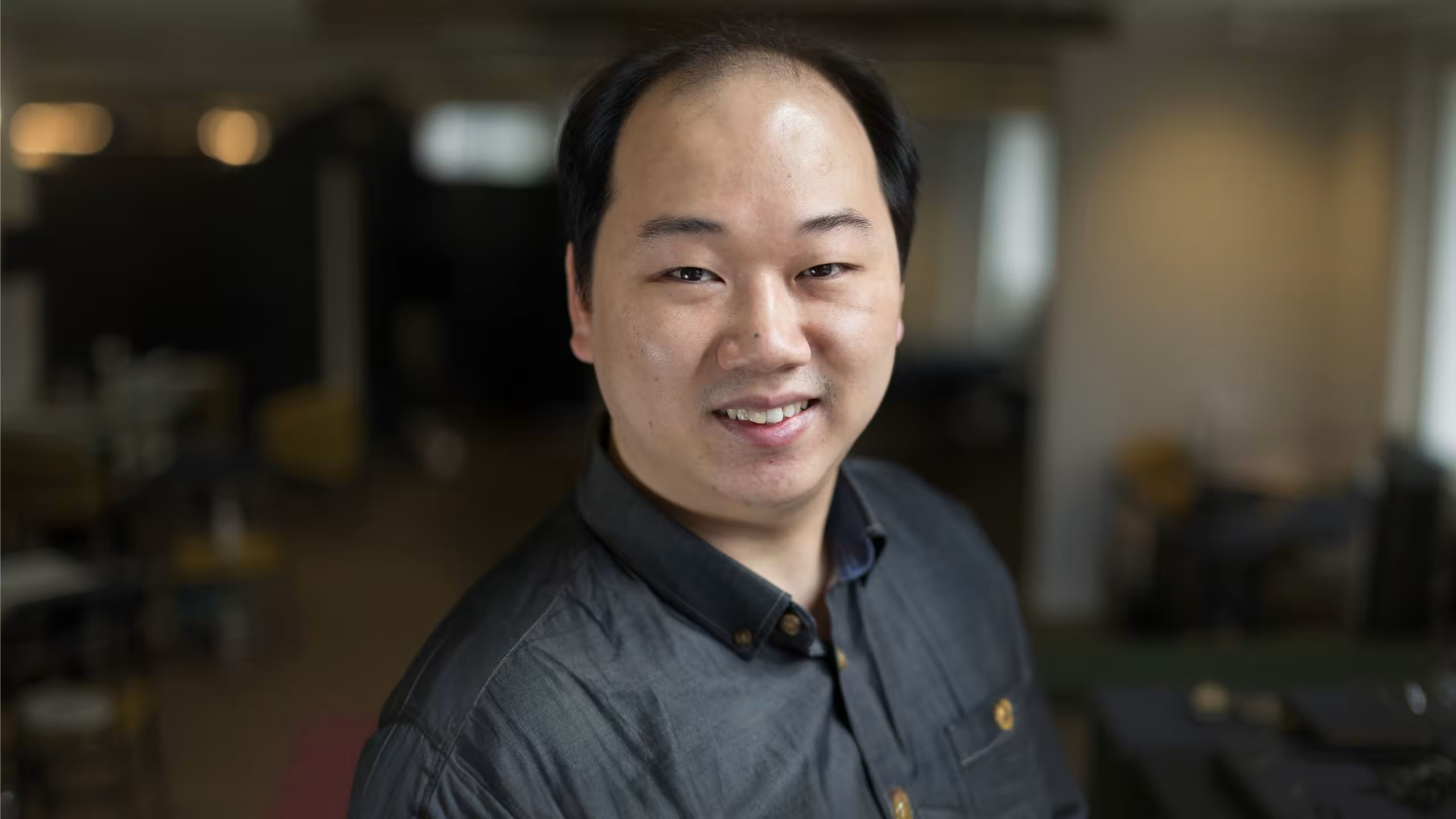
As a postdoctoral fellow at Sinai Health, Dr. Isaac Chang spends his days at the intersection of engineering and medicine. Working under the mentorship of Dr. Susanna Mak in the Harold and Esther Mecklinger and the Posluns Family Cardiac Catheterization Research Laboratory, he leads a team developing the Smart Tile — an innovative medical device designed to make tracking heart health almost effortless for patients.
What began as an idea during his PhD has evolved into a promising technology that could one day help people living with heart failure monitor their condition at home, simply by standing on a sensor similar in size to a bathroom scale.
We spoke with Dr. Chang about his path to biomedical engineering, the inspiration behind the Smart Tile and how his fellowship experience at Sinai Health is helping him turn research into real-world solutions.
Q: Can you tell me a bit about what inspired you to pursue biomedical engineering?
Dr. Isaac Chang: I chose biomedical engineering for both my undergraduate and graduate studies because I was fascinated by the application of engineering principles to the human body. But I knew I wanted to continue in this field when I built an electronic circuit that allowed me to see my own electrocardiogram (ECG) displayed on an oscilloscope, a device that shows electrical signals as waves on a screen. Watching my heart activity appear on a screen through a device I had built myself was incredible.
Inventing is exciting, but what has kept me engaged throughout my career is the opportunity to apply that technology to real health challenges — particularly conditions like heart failure that affect so many people.
Q: Can you describe the Smart Tile?
Dr. Isaac Chang: The Smart Tile is a prototype technology my team and I developed to provide non-invasive, easy-to-use monitoring for people living with heart failure. Our goal is to create what we call a “near-zero effort” tool that works completely in the background and requires virtually no active input from the patient.
We named it the Smart Tile because we imagined it functioning almost like a bathroom tile that’s simply there when you need it. A person just needs to stand on it and measurements are taken automatically, without attaching sensors, remembering instructions or learning how to operate a device.
Today, we’ve developed versions that can be used while standing, sitting on a chair and even lying down on a bed.
Q: And how does it work?
Dr. Isaac Chang: The Smart Tile works through a technique called ballistocardiography, or BCG. Every time your heart contracts and pumps blood through your body, it creates tiny mechanical vibrations. Those vibrations generate small reaction forces that can be measured. A simple way to imagine it is standing on a scale. While the scale appears to display a stable number, there are actually tiny fluctuations occurring all the time. Our technology captures those subtle signals and uses them to gather information about heart function.
One of the most exciting aspects of this approach is that BCG doesn't require direct skin contact. Measurements can be taken through clothing and even shoes, which makes the technology much easier to use than many conventional monitoring tools.
Q: Why is it important to create technology that requires almost no effort from patients?
Dr. Isaac Chang: The idea originally grew out of research involving people living with dementia, who often faced challenges using technology. We learned that even a small amount of effort required to operate a device could become a significant barrier.
That led us to explore the concept of "zero-effort technology" — technology that requires almost no learning, remembering or interaction from the user. As it turns out, similar challenges exist among patients with heart failure. About 70 per cent of people living with heart failure are over the age of 65, and many experience some degree of cognitive or physical decline.
Tasks that might seem simple, such as using a smartphone app, attaching a wearable device or even taking regular measurements with home monitoring equipment, can become difficult for these patients. We wanted to remove those barriers and create a tool that fits naturally into their daily life.
Q: What did you learn while testing the Smart Tile on patients?
Dr. Isaac Chang: Patient feedback has been critical to the Smart Tile's development. To better understand how people would interact with the technology, we recruited just over 100 patients through the Anna Prosserman Heart Function Clinic and the Cardiac Cath Research Lab at Mount Sinai Hospital.
Beyond collecting physiological data, we also sat down with many participants to learn about their experiences, asking what they liked about the device, what challenges they anticipated and how they felt about potentially using it at home. This was critical because technology only works if it works for the people who will ultimately use it.
Q: How could this kind of technology change care for patients in the future?
Dr. Isaac Chang: As sensor technology, artificial intelligence and smart-home systems continue to evolve, I believe tools like the Smart Tile could become a natural part of a patient's environment.
In the future, the technology could collect information automatically and securely share relevant insights with clinicians. One possibility is that machine-learning algorithms could identify subtle changes that might indicate a patient's condition is worsening, and flag those changes for medical teams before a serious health event occurs.
Of course, there are many technological, clinical, social and ethical considerations that still need to be addressed before systems like this become part of routine care. It takes a village to implement new technologies such as the Smart Tile. But the possibility of providing patients and clinicians with better information, while reducing the burden on both groups, is incredibly exciting.
Q: How has your experience as a fellow at Sinai Health shaped your work?
Dr. Isaac Chang: One of the greatest benefits of working at Sinai Health is being embedded in a clinical environment. As an engineer, I don't come from a clinical background. Being able to work alongside physicians, nurses and other health-care professionals has given me a much deeper understanding of patient care and clinical workflows.
I've also been fortunate to learn from my mentor, Dr. Susanna Mak, whose guidance has shaped how I approach research, mentorship, communication and patient-centred innovation. Developing a health-care solution isn't only about building technology. It's about understanding how that technology fits into the realities of patient care and clinical practice. That's something I've been able to learn firsthand at Sinai Health, and it's an experience that would be difficult to find elsewhere.
Q: What’s next for the Smart Tile?
Dr. Isaac Chang: Right now, we're focused on analyzing our research findings and publishing the results. We are so grateful to every participant for their involvement in the project so far.
Longer term, I'm excited to continue exploring what BCG signals can tell us about a person's heart function and overall condition. We're also interested in how the technology could be used beyond the home. For example, it could potentially provide additional information in community clinics or rural settings where access to specialized cardiac testing may be more limited.
Ultimately, my hope is that this work leads to practical tools that help patients and health-care professionals better manage heart disease, improving the lives of these patients and the loved ones who support them.
Related news and stories
View all News and Stories


