





When expertise meets reassurance: supporting families through IBD and pregnancy

For years, Laura Winning had learned to make decisions with Crohn's disease in mind. Diagnosed at 17 after years of fatigue, abdominal pain and other symptoms that had gone undiagnosed, Laura was eventually prescribed a treatment in her early 20s that transformed her quality of life and helped bring her Crohn’s disease into remission.
Yet, the disease remained a constant consideration. “Crohn's disease has been an undercurrent for decision-making and lifestyle choices, because I always have to think about what's going to impact my disease,” she says. “If my Crohn's disease is active, I struggle to work a full-time job, and I won't feel energized to enjoy other aspects of my life.”
When she began thinking about starting a family, the questions that had shaped much of her adult life gave way to new ones: Would pregnancy trigger a flare? Would her medications be safe? Could her disease affect her baby's health?
Those fears are common among people living with inflammatory bowel disease (IBD), a group of chronic conditions that includes Crohn's disease and ulcerative colitis. Many patients worry about fertility, pregnancy complications, medication safety and whether they could pass the disease on to their children.
“Pregnancy is already hard on your body," says Laura. "Adding Crohn's disease as a layer onto that created a lot of anxiety.”
At Sinai Health, those concerns are met with specialized expertise through the IBD Preconception and Pregnancy Clinic, led by gastroenterologist Dr. Vivian Huang. The program brings together experts across multiple disciplines to help patients navigate every stage of family planning, pregnancy and postpartum care.
For Laura, that support made all the difference. “I received an initial consultation early in my pregnancy, and Dr. Huang took the time to walk me through the risks, answer my questions and explain what to expect,” she says. “Just knowing I had access to the resources I needed took so much of that anxiety away.”
Bridging the gap between IBD and pregnancy care
IBD is increasingly being diagnosed in young adults, meaning more people are managing the disease during their reproductive years. Yet for many patients, uncertainty about pregnancy remains a significant barrier.
“Many patients are worried about whether they can get pregnant, whether pregnancy will worsen their disease, whether they should stay on their medications and how their IBD might affect their baby,” says Dr. Huang.
Those concerns can have profound consequences. Research has shown that some patients choose not to pursue pregnancy because of fears and misinformation about IBD and reproductive health. For those who do become pregnant, these fears and misinformation can lead to inappropriately stopping therapies or hesitancy to start therapies, resulting in ongoing active IBD at the time of pregnancy. At the same time, active disease before or during pregnancy can increase the risk of miscarriage, stillbirth, preterm birth and other complications.
Recognizing these challenges, Dr. Huang established a specialized IBD pregnancy clinic at Mount Sinai Hospital in 2018, building on a model she had developed earlier in her career.
She knew Mount Sinai was uniquely positioned to support this patient population. “We have one of the largest IBD programs, one of the largest high-risk obstetrical programs, outstanding colorectal surgery expertise and fertility specialists all under one roof,” she says.
Since launching the clinic, Dr. Huang has cared for more than 1,000 patients and supported approximately 700 pregnancies.
Meanwhile, the clinic has become a destination for trainees seeking to develop expertise in IBD and pregnancy care. “Our Sinai IBD fellows rotate through the Pregnancy IBD clinic during their fellowship with us,” says Dr. Huang. “Sinai Obstetrical Medicine and OB-GYN fellows have worked with me in the pregnancy clinic, and I've had trainees from other universities, such as McMaster, specifically come here for an elective so that they can work with me in the pregnancy clinic.”
Connecting patients to the expertise they need
Every patient arrives with a different set of circumstances.
Some need help optimizing disease control before conception. Others require fertility assessments, nutritional support or guidance around complex medication or surgical decisions. Many have additional health conditions that require coordination among multiple specialists.
The clinic's multidisciplinary model helps bring those pieces together. “We want patients to receive consistent, evidence-based advice,” says Dr. Huang. “That means collaborating with gastroenterologists, maternal-fetal medicine specialists, colorectal surgeons, fertility experts and other specialists involved in their care.”
For Laura, that coordination was invaluable.
In addition to specialized IBD monitoring throughout pregnancy, she received care through Sinai Health's high-risk pregnancy team, and she was connected with experts who could answer questions about how her medications might affect her baby after birth. “I felt like I had all the right specialists at the right time,” says Laura. “You want to see the experts.”
That collaborative care continues to evolve. One example is a referral pathway developed with Toronto’s Hospital for Sick Children that provides assessment and counselling for infants exposed to biologic medications during pregnancy. The partnership has helped advance research and contributed to changes in international guidelines regarding childhood vaccinations for these babies.
From research discoveries to real-time care
As one of Canada's leading experts in IBD and pregnancy, Dr. Huang is helping advance research that informs care both nationally and internationally.
She recently served as one of only two Canadian contributors to updated international guidelines on IBD and pregnancy. Her team is also conducting research that addresses unanswered questions facing patients and clinicians.
One emerging initiative is the donor-funded BabyGEM (Genetic, Environmental, Microbial), a translational research program that builds on Sinai Health's internationally recognized GEM Project, led by Dr. Ken Croitoru, a renowned Sinai Health gastroenterologist. Supported by philanthropy, the landmark GEM study has helped researchers better understand how genetics, the environment and the microbiome contribute to the development of Crohn's disease.
Dr. Huang's BabyGEM program extends those questions to the earliest stages of life, exploring how maternal IBD influences infant health, the developing microbiome and future disease risk. Researchers are studying how active disease during pregnancy might affect breast milk composition, infant gut health and other early-life factors that could shape a child's long-term health.
“We’d like to better understand whether children born to mothers with active IBD, or to mothers unable to take medication during pregnancy, experience changes in their microbiome or face a higher risk of developing IBD themselves, with the future aim to identify ways to intervene and reduce the risk,” Dr. Huang says.
Philanthropy has also enabled the clinic to embrace innovative tools to advance care in real time. Among the most promising is intestinal ultrasound, a technology that allows clinicians to assess disease activity during a clinic visit without invasive testing. The approach enables physicians to identify inflammation immediately, helping patients better understand their disease and make informed treatment decisions.
Philanthropy helping drive the future of care for pregnant IBD patients
The clinic's ability to innovate depends in part on philanthropic support. For decades, Sinai Health has been a leader in IBD care, bringing together clinical expertise, research and education through its Centre for Inflammatory Bowel Disease. That leadership has helped drive advances in diagnosis, treatment and disease prevention, while creating opportunities to develop specialized programs for patients with unique and complex needs.
Donor generosity is essential to sustaining and strengthening programs like these, accelerating research discoveries and ensuring patients have access to the specialized expertise they need.
For Dr. Huang, donor support also helps sustain care coordination and program growth. Her vision includes expanding access to intestinal ultrasound for preconception and pregnant patients and eventually establishing a dedicated fellowship in IBD and pregnancy care. Such a program would build on Sinai Health's internationally recognized Advanced IBD Fellowship, creating a specialized training pathway for clinicians seeking expertise at the intersection of IBD and reproductive health.
For patients like Laura, the value of that investment is already clear.
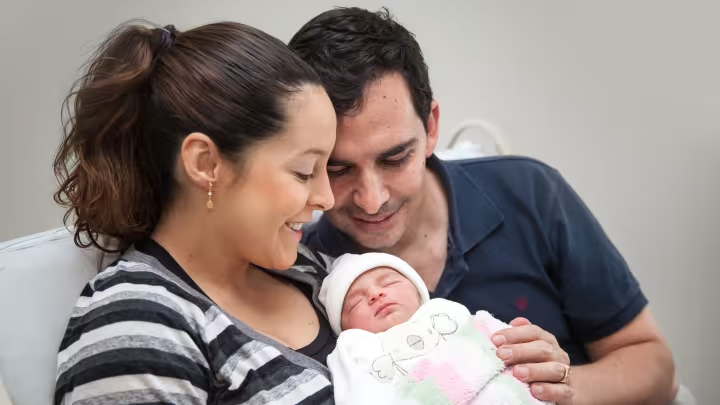
Today, she is the mother of two healthy boys. Both pregnancies remained stable, and her Crohn's disease stayed in remission each time.
Looking back, she remembers leaving her first appointment with Dr. Huang feeling a confidence she hadn't felt before. “I walked away feeling like we had a plan,” she says. “I knew I was receiving the best care possible, and that if anything happened, I had the support I needed.”
You can help transform the future of care for patients like Laura
Sinai Health is recognized internationally for its leadership in IBD research, education and patient care. From pioneering research programs and advanced fellowship training to specialized clinics such as the IBD Preconception and Pregnancy Clinic, Sinai Health is helping define the future of care for people living with Crohn's disease and ulcerative colitis.
As more young adults are diagnosed with IBD, support for Dr. Vivian Huang and her team's work has become increasingly important. Your support helps strengthen innovative programs, accelerate research discoveries and ensure patients and families receive the specialized care they need at every stage of life. Donate today.
Related news and stories
View all News and Stories


