

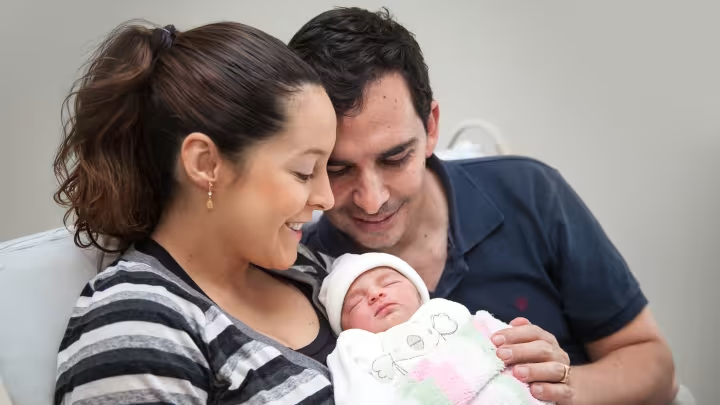




A more precise path through prostate cancer

From advanced diagnostics and robotic surgery to emerging AI tools, Hugh’s story reflects a new era of personalized care.
For most of his adult life, Hugh Ralph had good reason to pay attention to his prostate health.
Both his father and grandfather had been diagnosed with the disease. His father’s cancer eventually spread to his bones, and Hugh saw firsthand the suffering his father endured toward the end of his life.
So, Hugh was vigilant. After an initial biopsy nearly two decades ago found no cancer, he continued with regular prostate-specific antigen (PSA) blood tests.
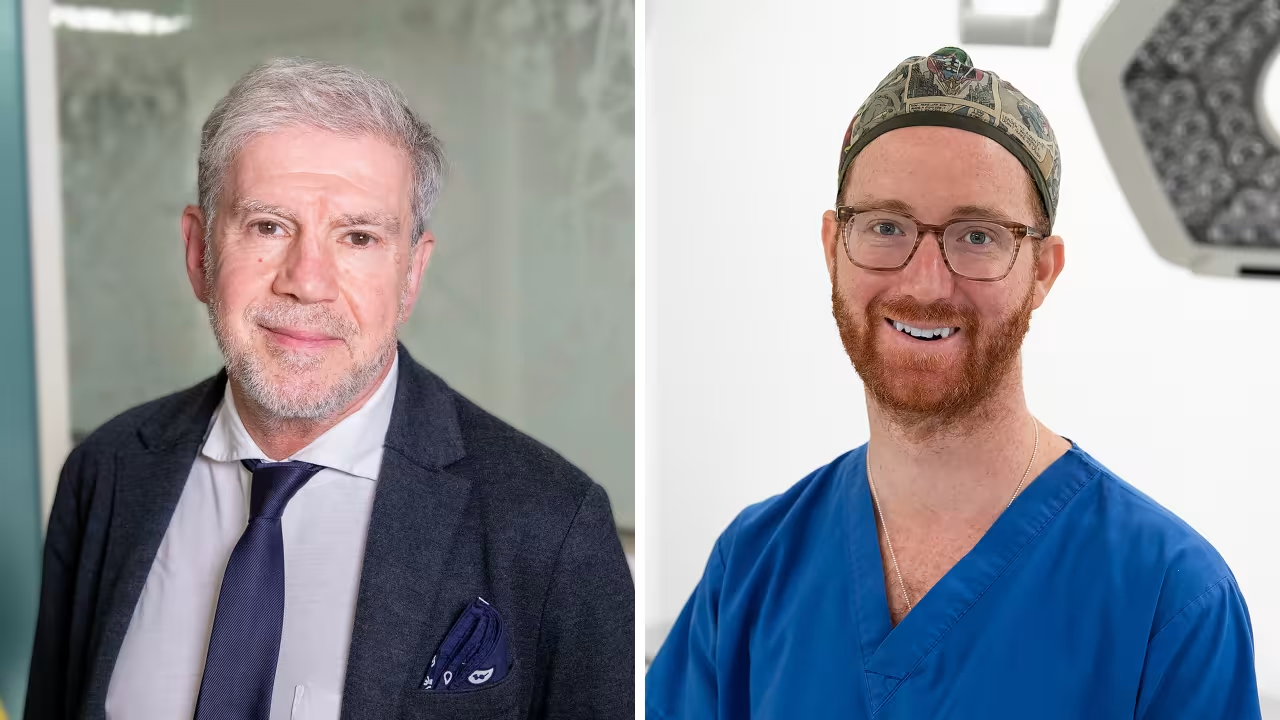
In 2016, he transferred his care to Dr. Alexandre Zlotta, Sinai Health’s Director of uro-oncology and Howard Sokolowski Chair in Uro-Oncological Research, who had previously treated Hugh’s wife for bladder cancer.
For years, Hugh’s PSA levels fluctuated without causing concern. Then a higher reading in 2023 prompted an MRI – the first step in a diagnostic journey that would reveal how increasingly sophisticated tools, and clinicians willing to keep looking when the evidence doesn’t quite fit, are changing prostate cancer care.
The search for better answers: finding the cancers that pose a threat
PSA testing is an important tool for detecting prostate cancer, but it has significant limitations. Many men harbour prostate cancer cells that will never threaten their lives. The challenge, explains Dr. Zlotta, is identifying which cancers are likely to cause harm while avoiding unnecessary investigation and treatment of those that won’t.
“Our research,” he says, “aims to develop smarter and more personalized ways to detect prostate cancer.”
His team is investigating how individual risk factors, blood tests and other biomarkers, genetic information and advanced imaging such as MRI can be brought together to identify aggressive cancers earlier, while reducing unnecessary biopsies and treatment for slow-growing cancers.
Artificial intelligence could further help physicians answer one of prostate cancer’s biggest questions with greater confidence: who needs further testing, and who does not. Using data from approximately 46,000 men across North America, Europe and Asia, Dr. Zlotta and collaborators are developing AI tools that combine imaging, biomarkers and individual risk factors to estimate an individual’s risk of aggressive prostate cancer.
The technology is intended to augment, not replace, clinical expertise — providing more precise information to inform conversations between physicians and patients. “The overarching goal of our research is to help and guide patients like Hugh,” says Dr. Zlotta.
When the first answers weren’t enough
For Hugh, an MRI identified suspicious areas that warranted a closer look.
But Hugh’s first biopsy produced a puzzling result: It detected only low-grade cancer, which didn’t appear to match what doctors were seeing on the MRI. Dr. Zlotta told him the readings were inconsistent with what the biopsy was showing.
Rather than accept the reassuring biopsy result, Dr. Zlotta brought Hugh’s case to Sinai Health’s multidisciplinary prostate tumour rounds, where specialists review complex or unusual cases together. The team recommended another biopsy, this time using a transperineal approach.
For Hugh, that decision to do a second biopsy proved pivotal.
Unlike a traditional transrectal biopsy, a transperineal biopsy uses a different route to reach the prostate, allowing physicians to target suspicious areas seen on MRI while reducing the potential risk of infection.
During Hugh’s second biopsy, the team used his MRI images to help target the suspicious areas, which helped provide the answer they had been seeking: His cancer was more significant than the earlier biopsy suggested, and treatment was now recommended.
Looking back, Hugh says Dr. Zlotta’s decision to keep investigating was one of the defining moments of his care. “That decision made a real difference,” he says. “To actually not just let it go, but to push it.”
Where medical evidence meets patient preference
Once Hugh’s cancer had been characterized, the focus shifted from finding it to deciding how best to treat it.
He met with specialists to discuss radiation and surgery. In prostate cancer, Dr. Zlotta explains, different treatments can offer comparable cancer control while carrying different potential side effects. That makes the patient’s priorities an essential part of the decision.
Dr. Christopher Wallis, the urologic oncologist who would perform Hugh’s surgery, describes the process as shared decision-making. “There’s a back and forth between the medical information we can provide and the lived experience the patient brings,” says Dr. Wallis. “Through shared decision-making, we can arrive at the best choice for that individual — one they’ll feel comfortable with long term.”
After hearing the risks and benefits of radiation versus surgery, Hugh and his wife didn’t take long to decide. “Within a minute after having the consultation, we walked out and said, ‘Surgery,’” he recalls.
Hugh underwent a robotic prostatectomy with Dr. Wallis in 2025. Dr. Wallis was recruited to Sinai Health about five years ago to help build its robotic surgery program. Experience in high-volume robotic surgery can help improve cancer control while protecting quality of life outcomes, including urinary and sexual function where possible.
Hugh spent one night in hospital and went home with a catheter that was removed several days later. His recovery has included pelvic-floor exercises to help restore urinary control, while regular PSA tests monitor for signs of recurrence.
Today, he says he is “back to normal” and pleased with his progress.
Precision with patient-centred care
Hugh’s journey captures a broader shift underway at Sinai Health toward increasingly individualized prostate cancer care.
Artificial intelligence is opening further possibilities. Hugh's story illustrates why better answers matter. A single biopsy didn't tell the whole story — but advanced imaging, multidisciplinary expertise and emerging research helped reveal the cancer that needed treatment. Philanthropy is helping researchers build even better tools so that more patients receive the right diagnosis at the right time.
For Dr. Wallis, continued research is about building on the care patients receive today. “We want to make sure we do the best we can for people today, but an even better job for the people who come next week, next month and next year,” he says. “This is where we are; this is what we’ve got. But we’re always asking how we can do better.”
For Hugh, that philosophy was already evident in care that combined advanced imaging, targeted biopsy, multidisciplinary expertise and robotic surgery with something decidedly human: physicians who explained his choices, listened to his priorities and kept looking when the evidence didn’t add up.
Asked whether he felt supported in making one of the biggest decisions of his life, Hugh doesn’t hesitate. “Full support in explaining it and leaving it up to me,” he says. “And then full engagement once I made the decision.”
Help bring the future of prostate cancer care closer
A donation to Sinai Health can accelerate research into more precise ways to detect and understand prostate cancer, helping clinicians identify the cancers that need treatment while sparing others unnecessary tests and interventions. By investing in research at Sinai Health, you can help advance the next generation of diagnostics and more personalized care, giving more patients, like Hugh, the answers they need to make informed decisions about their health. Donate today.
For more information, please contact:
Lauren Dzenis, Philanthropy Director
[email protected]
Related news and stories
View all News and Stories


