





How technology is revolutionizing cardiac care
When J.J. noticed her foot swelling and found herself short of breath climbing stairs, she assumed she was overtired. But within weeks, a series of tests revealed something far more serious: her heart was functioning at just five per cent.
“It was scary,” J.J. recalled. “It wasn’t a regular heartbeat. It was beating very slowly.” By comparison, a healthy heart pumps out 55 per cent of blood in its main chamber with each heartbeat — meaning just over half the blood is pushed forward every time the heart contracts.
At 66, with no family history of heart disease, J.J. and her partner, Clarence, were stunned to learn just how incapacitated her heart was. “We knew it was a heart issue,” Clarence says, “but we didn’t know how bad it was until Dr. Brahmbhatt gave us the proper diagnosis.”
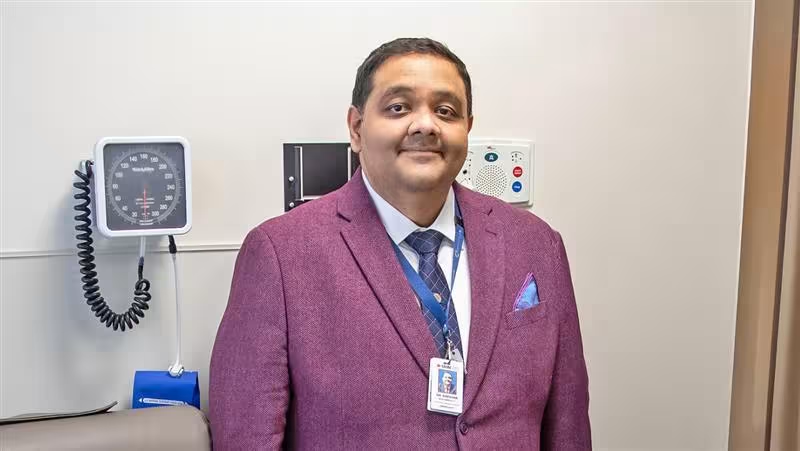
Dr. Darshan Brahmbhatt, a staff cardiologist at the Anna Prosserman Heart Function Clinic within the Miles Nadal Heart Centre at Sinai Health, diagnosed J.J. with non-ischemic cardiomyopathy, a type of heart muscle disease that affects its ability to pump blood effectively.
J.J.’s condition was so severe that doctors initially began preparing her for a possible heart transplant. But under the care of Dr. Brahmbhatt, another path emerged — one that reflects how advances in cardiac technology are reshaping the future of heart failure care.
February is Heart Health Month, a time to spotlight both the complexity of living with heart disease and the innovation transforming outcomes for patients like J.J.
Reducing barriers to care by harnessing the power of technology
Much of Dr. Brahmbhatt’s work focuses on digital monitoring and remote care — tools that allow physicians to adjust medications and intervene early without requiring repeated hospital visits.
His groundbreaking research, using a patient-centred remote monitoring system, has shown remarkable improvements in heart failure management. Today, he’s expanding the program at Sinai Health, allowing more patients to receive timely medical guidance outside of regular clinic hours. His goal is to position Sinai Health as a leader in heart failure innovation, using technology to improve patient outcomes both locally and beyond.
“The whole idea of digital technology is that we can flatten the barriers that exist to accessing care,” Dr. Brahmbhatt says. “People who work during the day may have to take a day off work just to be assessed. I’d like to see us using digital technologies to provide a high level of monitoring that doesn’t require them to visit the hospital every time, saving people the hassle of spending three to five hours fighting traffic in Toronto and paying for parking.”
Dr. Brahmbhatt’s team is also testing new non-invasive diagnostic tools, including mobile sensors that can capture detailed cardiac data in seconds. “It is so much better,” he says, “getting that information without having to do an invasive test.”
A different path forward
For J.J., improved quality of life meant avoiding a transplant and instead improving her condition enough to receive an implantable cardioverter defibrillator. “Dr. Brahmbhatt came up with an alternate plan to a transplant,” she says.
Dr. Brahmbhatt explained that with the defibrillator, the team would be able to resynchronize the heart. “That’s where we make the left and right sides of the heart work together more efficiently,” he says. “The device can actually revolutionize the heart function back to the normal levels.”
The months leading up to the procedure were marked by rehabilitation, medication and careful monitoring. “I went to rehab for three months to build up my strength,” J.J. says.
Today, the transformation is striking.
“I feel good,” says J.J. “I play pickleball four times a week. I do my exercises, I walk. I’ve got lots of energy.”
Her follow-up visits with Dr. Brahmbhatt have gone from weekly to yearly. “Because he says I’m doing okay,” she says.
Philanthropy powers progress
None of this innovation happens in isolation. Our community of supporters continue to play a pivotal role in building world-class cardiac programs that make this work possible.
The Miles Nadal Heart Centre draws patients from across Ontario and beyond, many seeking expertise in complex conditions such as advanced heart failure, cardiac concerns during pregnancy, and disorders like sleep apnea that can affect heart health.
The centre is also home to Canada’s only cardiac catheterization lab dedicated to research.
Using advanced imaging technology to study the heart in action, clinicians and scientists are working to deepen understanding of how the heart functions — from the effects of exercise to important differences between men’s and women’s cardiovascular health. This integration of patient care and research shapes both the experience patients receive today and the treatments that may define cardiac care in the future.
Dr. Brahmbhatt is grateful to the Sinai Health community for its support for advancements in cardiac technology. He says that while he and his colleagues receive some government support, “otherwise we are entirely reliant on tech being developed through philanthropy. So much of the smart technology we are developing comes from our donors and people supporting our clinic and our research,” he says. “And that's a key part of what we do.”
A return to the activities she loves
For J.J., the impact of that progress is deeply personal.
“It feels good to be able to move again,” she said. “I don’t think I would be here without the help of my physicians.”
Her story reflects what Heart Health Month is ultimately about: not just awareness, but action, and the belief that with the right care, technology and support, even the most fragile hearts can find their way back to strength.
As cardiac care continues to evolve at Sinai Health, patients like J.J. are proof that innovation, guided by compassion and generosity, can truly transform lives.
You can help advance transformative care for patients like J.J.
When you support Sinai Health, you help empower the next generation of cardiac leaders, like Dr. Brahmbhatt, to harness innovative technology and advance care for people living with heart failure. Donate now.
Related news and stories
View all News and Stories


