


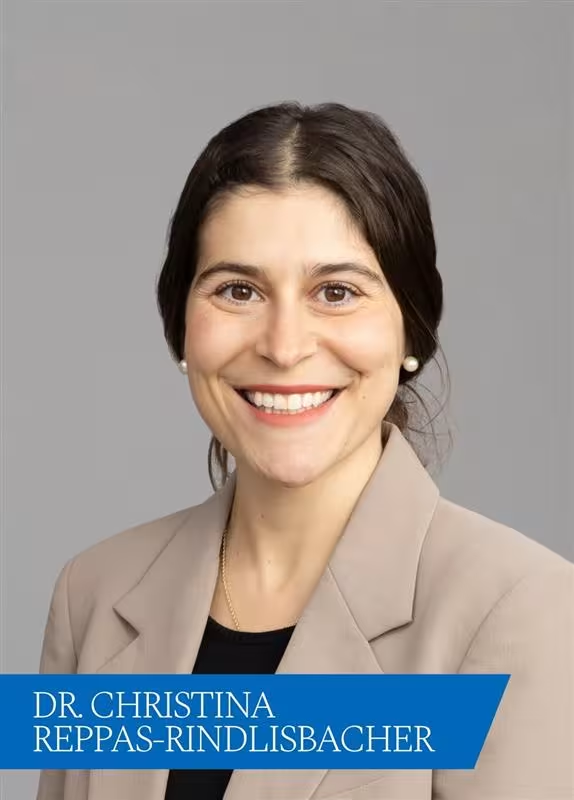
Meet the Minds: Dr. Christina Reppas-Rindlisbacher turns research into practice to elevate the standard of Geriatric care
In a country as diverse as Canada, the care that patients receive – and the health outcomes they experience – should not depend on the language they speak.
Dr. Christina Reppas-Rindlisbacher, a Geriatrician at Sinai Health and UHN who is completing her PhD in Clinical Epidemiology, explores differences in care for older adults who speak a language other than English. Her work sits at the intersection of Geriatrics, equity and epidemiology — and she sees the aging population as an opportunity to reshape care for the better.
Q: There’s a well-documented need for more Geriatricians in Canada. As our population ages, what challenges – and opportunities – do you see?
Dr. Reppas-Rindlisbacher: The challenge is clear: the demand for health care is going to surge, and more people will live with long-term health challenges that are associated with aging and chronic diseases.
But I also see this as an opportunity to invest in preventative efforts to promote healthy aging — things like high-value community care and home care that help older people stay independent, active and out of hospital. And for those who do come to hospital, we need to invest in strategies that avoid the hazards of hospitalization, such as delirium and immobility.
Q: What drew you to Geriatrics, and what do you find most rewarding about working with older adults?
Dr. Reppas-Rindlisbacher: I was first drawn to Geriatrics when I worked a summer job as a physiotherapy assistant in a long-term care home during my undergrad years. I loved listening to the residents’ stories and helping them stay as independent as possible through walking and exercise. Later, in medical school, I realized how enormous the need was — and how few students were choosing this field. I also saw the incredible opportunity to lead change in a health system caring for a growing aging population.
The most rewarding part of Geriatrics is the time I spend supporting older adults and their families. There are rarely “cures” in Geriatric medicine, but patients and families are so appreciative because I’m helping them find ways to improve quality of life, remain independent and stay focused on what matters most to them.
Q: Your research explores how a patient’s preferred language affects the care they receive in hospital and, ultimately, their health outcomes. In a city as diverse as Toronto, why is this issue so urgent?
Dr. Reppas-Rindlisbacher: It is a human right for patients to have their health-care communication delivered in a language they understand. In Toronto, 46 per cent of older adults report a mother tongue other than English, so the need for linguistically-appropriate care is massive. This is especially urgent for older adults because they must be able to describe symptoms to ensure accurate diagnoses and correct treatments. We know that language discordance has been linked to medical error, delays in access to surgery and repeat hospital admissions.
Q: Can you illustrate how a patient with a non–English language preference can experience barriers to quality care while in hospital?
Dr. Reppas-Rindlisbacher: Barriers occur at every stage of hospitalization, especially for older patients. From the moment a patient arrives in the ER, they’re triaged based on an interview, then tests are ordered based on the patient’s history. Once admitted, all our age-friendly health strategies also depend on communication. Asking for a glass of water or to go to the bathroom, expressing pain – if these are neglected, older patients are at risk of losing their independence and developing delirium.
During hospitalization, we also discuss a patient's care goals and help make important decisions about their health. While a person may manage basic tasks in English, like going to the bank or grocery store, important discussions about something like cancer treatment must be delivered in their preferred language so they can make truly informed decisions.
Q: You recently published research looking at the risks among older patients undergoing hip fracture surgery who had a non-English language preference, most commonly Italian, French, Chinese, Portuguese and Greek. What did you find?
Dr. Reppas-Rindlisbacher: We looked specifically at the experience of older patients in Ontario who presented to the emergency department with a hip fracture and then underwent surgery. And we found that among this group, the patients with a non-English language preference spent more days in hospital and faced additional barriers to surgical recovery — including a higher risk of delirium and a higher likelihood of being discharged to long-term care.
Hip fractures are already life-changing events for older people, so it's critical that we ensure every person has the same opportunity for recovery.
Q: Why does language preference contribute to poorer outcomes, such as delirium?
Dr. Reppas-Rindlisbacher: Imagine waking up from surgery, the sedation wearing off, hearing instructions in a language you don’t understand and not being able to communicate your needs or fears.
This is just one moment that can worsen delirium for non-English speakers, but the issue is much broader.
We know that delirium-prevention strategies are important in keeping older people healthy while they’re hospitalized – but all of these rely on communication. How can we enhance mobility when we can’t clearly explain the steps to getting out of bed after hip surgery? How can we accurately assess pain? When communication fails, patients can become frustrated and scared, which can be misinterpreted as “agitation”. This can lead to sedatives or physical restraints being used, both of which put patients at further risk.
Q: Another study of yours examined restraint use among older adults with dementia who prefer non-English languages. What mattered most in those findings?
Dr. Reppas-Rindlisbacher: I have published two studies showing that older patients who don’t speak English are more likely to be physically restrained in hospitals. We know such restraints are associated with pneumonia and injuries as well as emotional harms like distress, panic and worsening of confusion. Now that we know this inequity exists, we need to design interventions that specifically help the populations most at risk. That’s something I’m actively working on.
Q: What about the challenges that caregivers and care teams experience with patients who do not speak English?
Dr. Reppas-Rindlisbacher: We know that front-line nurses and doctors are not given specific training or time to use interpreters – this needs to change. And caregivers are too often put in unfair situations where they're being asked to interpret sensitive or complex information, such as asking about capacity to make decisions. Also, caregivers are not trained in medical interpretation so, although they’re important members of the care team, we should not be relying on them to interpret complex medical information.
Q: Your findings have been described as a “call to action”. What should hospitals be doing right now to improve language-accessible care?
Dr. Reppas-Rindlisbacher: Several things:
- Make interpretation services more widespread and accessible — and empower patients and caregivers to ask for them.
- Allow flexible visitation, including letting family into the PACU after surgery and making overnight stays easy.
- Offer hospital information in the top languages spoken by our patients.
- Book appointments with the extra time required for professional interpretation. For example, a cognitive assessment using an interpreter may need up to 50 per cent more time.
Q: How is Sinai Health putting research findings into practice?
Dr. Reppas-Rindlisbacher: Sinai Health is at the forefront of supporting interpretation and translation services, providing in-person interpreters in 65 languages — including American Sign Language — and on-demand video interpretation in nearly 200 languages, often in less than two minutes. Recently, there was a multicultural, multilingual book and magazine drive to meet the needs of our diverse older patients by providing cognitively-stimulating material in many languages.
Sinai Health’s flexible visitation policy also makes it easier for caregivers and families to be present in the hospital.
Q: The Summer Scholar program gives medical students an opportunity to participate in research supervised by a Geriatrician. How does this help address the need for more Geriatricans?
Dr. Reppas-Rindlisbacher: This program, which is entirely funded by philanthropy, is incredible. Two years ago, I supervised a student who completed a research project through Summer Scholars. She was interested in Geriatrics but unsure about pursuing it as a career. Through the program, she spent a week with a Geriatrician to see firsthand what we do and she led a meaningful project evaluating restraint use. She later had the opportunity to present it – and win an award – at a conference where she connected with a community passionate about caring for older adults.
This student is now planning to pursue a subspeciality in Geriatric medicine. This is exactly what the Summer Scholars program does: it shows students the impact they can have and how rewarding Geriatrics can be.
Want to support this and other research that supports our aging patients? Donate today. Please select Other and enter Geriatric Medicine as your desired gift designation.
Related news and stories
View all News and Stories


