



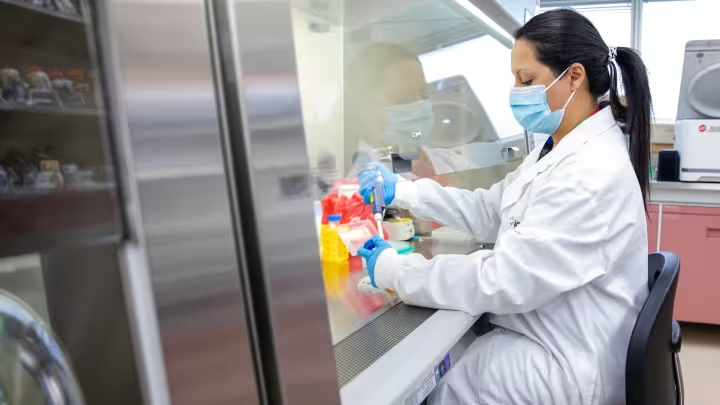
Dr. Selin Jessa
Lunenfeld-Tanenbaum Research Institute
Decoding the rules of gene regulation
During development, proper cell function relies on genes being expressed in the right time, place and quantity. This regulation is in part controlled by the binding of transcription factors – proteins which bind specific sequences of DNA – in the 99% of our genome that does not encode proteins.
We are a computational biology lab studying these fundamental mechanisms of gene regulation. We investigate how just ~1600 transcription factors collectively regulate thousands of genes across hundreds of cell types during development. Then, we characterize how these mechanisms are disrupted in rare disease. To answer these questions, we combine systematic analysis of functional genomics data from healthy and patient-derived tissues with cutting-edge interpretable deep learning approaches.
By learning the basic DNA sequence rules underlying gene regulation in development, we ultimately aim to engineer and program these rules for targeted therapeutics, contributing to recent advances in genomic medicine.

Email: [email protected]

Room 875, 600 University Avenue
Toronto, M5G 1X5

Website: Jessa Lab
Publications: PubMed
Google Scholar: Selin Jessa
ORCID: 0000-0003-4192-6523
LinkedIn: Selin Jessa
Bluesky: @selinjessa.com
- 2026–present; Investigator, Lunenfeld-Tanenbaum Research Institute, Sinai Health, Toronto
- 2026–present; Assistant Professor, Department of Molecular Genetics, University of Toronto, Toronto
- Postdoctoral fellowship, Department of Genetics, Stanford University, Stanford, CA, USA; 2023–2026
- PhD, Quantitative Life Sciences, McGill University, Montreal, Canada; 2018–2023
- BSc, Joint Honours, Computer Science and Biology, McGill University, Montreal, Canada; 2013–2017
- 2024 – CIHR Banting Postdoctoral Fellowship
- 2024 – Wu Tsai Neurosciences Institute Interdisciplinary Postdoctoral Fellowship
- 2023 – Governor General’s Gold Medal, McGill University
- 2020 – Frederick Banting Canada Graduate Scholarship – Doctoral
- 2019 – FRQS Doctoral Training Scholarship
- 2013 – TD Scholarship for Community Leadership
We are interested in fundamental mechanisms of cis-regulation, which control gene expression at the right time, place, and quantity. We're particularly interested in how gene regulatory programs are established during development, how they're disrupted in disease, and how they can be engineered or targeted for therapeutics. To answer these questions, we combine functional genomics data analysis with state-of-the-art interpretable deep learning models to use DNA sequence (As, Cs, Gs, and Ts) to predict these readouts - and then we interpret these models to understand what they learned.
How does cis-regulatory logic allow cells to activate cell type-specific gene expression programs from common developmental cues?
During development, cells use external signals and intrinsic regulatory factors to activate transcription of the right genes at the right time and place. Remarkably, all the cell types in the human body reuse approximately a dozen developmental signaling pathways, which terminate in binding of DNA sequence-specific transcription factors (TFs) in cis-regulatory elements (CREs) in the regulatory genome. How do cells achieve cell type-specific responses to these common cues? We’ll study the cis-regulatory logic that mediates cell signaling responses - and understand how organization or “syntax” of TF binding sites (composition, order, spacing, orientation, flanks, affinity) in CREs enables integration of inputs and cell type-specific responses to signaling pathways.
Representative publications:
- Liu, Jessa et al., Multiomics and deep learning dissect regulatory syntax in human development, Nature, 2026.
How is cis-regulatory logic disrupted in disease, and how can it be programmed to design gene therapies?
Changes to the DNA sequence in cis-regulatory elements can change the cell context, quantity, and timing of gene expression. We use deep learning models trained in disease and developmentally-relevant tissues to predict and understand effects of non-coding variants in disease. In turn, we these models to design sequences and sequence changes to alter or program gene regulation for therapeutic applications.
Representative publications:
- Liu, Jessa et al., Multiomics and deep learning dissect regulatory syntax in human development, Nature, 2026.
- Wang, Jessa et al., Sensitive, direct detection of non-coding off-target base editor unwinding and editing in primary cells, bioRxiv, 2025.
We are looking for curious, collaborative, creative scientists to join our team!
Graduate students
Our research group is part of the Molecular Genetics department at the University of Toronto, which has a central admission committee and a rotation system. Graduate students interested in doing a PhD in the laboratory must first be accepted in Molecular Genetics. First-year students should email Selin to discuss rotation opportunities.
Summer students
Summer students are exclusively selected from successful applicants to the Research Training Centre (RTC) at the Lunenfeld-Tanenbaum Research Institute. Applications are available online and need to be filled by February 28th of each year.
Notable publications
Nature, 2026
bioRxiv, 2025
Nature Genetics, 2022
Cell, 2020
Nature Genetics, 2019
Join our team
Visit our job board to see research positions.