


Meet the newest scientists advancing discovery and translational research at Sinai Health
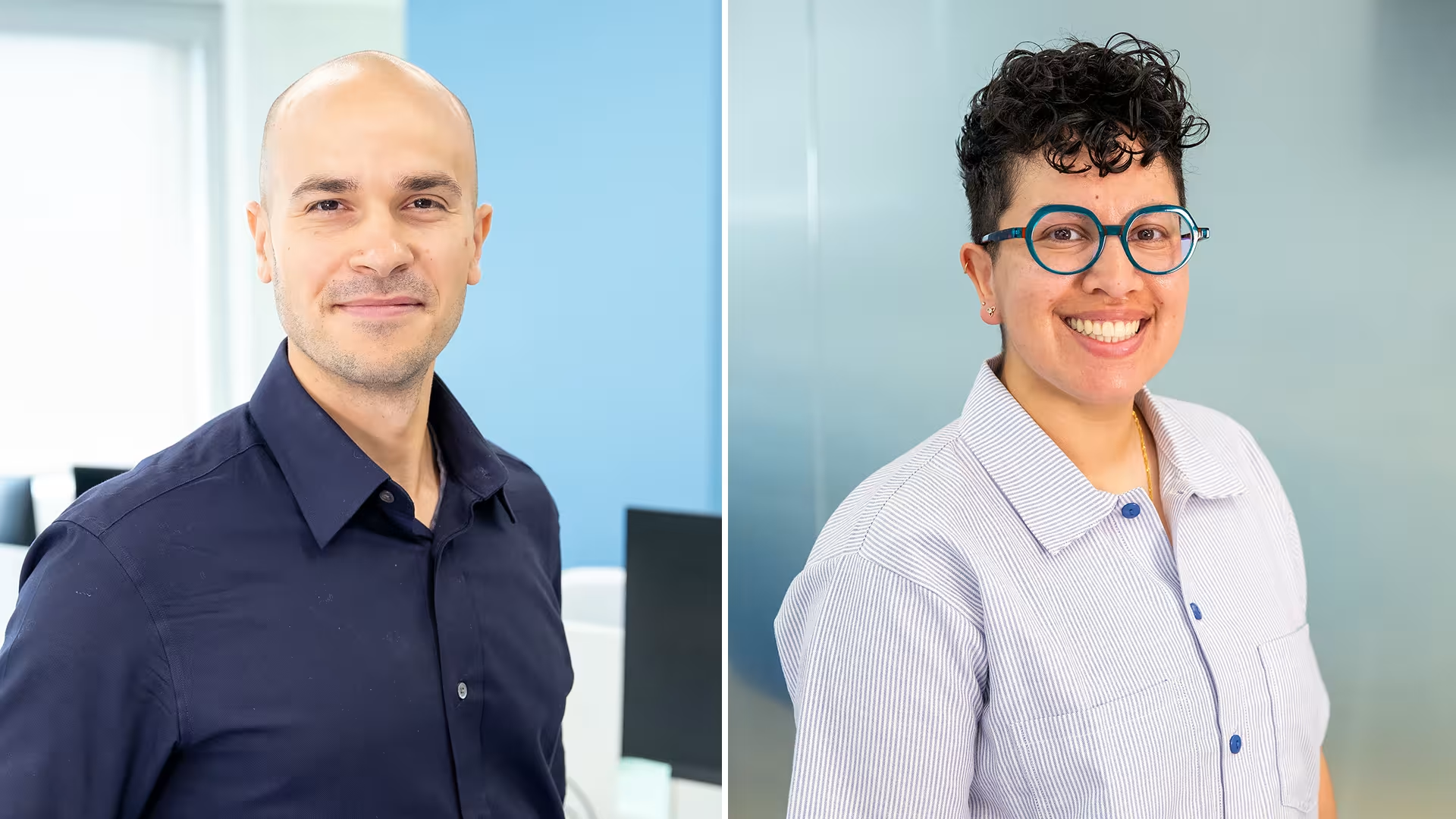
Drs. Vasily Giannakeas and Selin Jessa join the Lunenfeld-Tanenbaum Research Institute (LTRI) as its newest researchers.
Drawing on backgrounds in developmental biology, advanced computational approaches and cancer epidemiology, the pair bring fresh perspectives that build on LTRI's reputation for discovery and translational research.
Their recruitment reflects LTRI’s ongoing commitment to attract rising talent in biomedical research, helping to reinforce the institute’s standing on the global stage. Both also hold appointments as assistant professors at the University of Toronto (U of T).
"I am thrilled to welcome Drs. Vasily Giannakeas and Selin Jessa to LTRI as they launch their research programs here," says Dr. Anne-Claude Gingras, Director of LTRI and Vice President of Research for Sinai Health. "Both are exceptional emerging research leaders who are willing to ask bold questions and pursue innovative approaches. Their work addresses fundamental questions in health and disease and will open exciting new opportunities for discovery and collaboration across Sinai Health and beyond."
Mining health data to redefine early cancer detection
Dr. Vasily Giannakeas, a translational research scientist at LTRI and the Weston O’Born Centre for Mature Women’s Health at Sinai Health is using large-scale health data to detect women’s cancer earlier, before symptoms appear. He is also an assistant professor at the Dalla Lana School of Public Health at U of T.
Trained initially as a chemical engineer, Dr. Giannakeas shifted to epidemiology and public health after a co-op at Harvard-MIT Health Sciences and Technology, working on microfluidic devices, technology that performs complex lab tests using microscopic amounts of liquid. He went on to complete a master's and PhD in epidemiology at the University of Toronto, training with Dr. Steven Narod, one of the world's leading breast and ovarian cancer researchers.
His research rests on the premise that vast amounts of health data, collected for administrative or clinical purposes, go underutilized. Using Ontario's laboratory database—hundreds of millions of blood test records linked to a provincial registry of cancer cases and deaths—he has found that platelet counts are often significantly elevated in people later diagnosed with cancer. The finding points to a larger goal: combining blood-based signals with demographic and clinical data in machine learning models that flag high-risk patients for earlier detection of cancer.
His earlier research applying similar methods to breast cancer treatment decisions was published in JAMA Oncology and featured in The New York Times, and has since informed how surgeons counsel patients from lumpectomy to mastectomy decisions.
In his own lab at LTRI, Dr. Giannakeas is turning his attention to electronic medical records, working to structure and analyze this data with machine learning and other artificial intelligence tools to advance research in breast and ovarian cancer. This effort gains new momentum as Sinai Health transitions to an Epic electronic patient record (EPR) system that will unify patient data on one, integrated platform.
“We’re going to have the opportunity to leverage this longitudinal data within the patient population at Sinai Health to address important research questions and improve patient outcomes,” says Dr. Giannakeas.
He says Sinai Health's collaborative research community was a major attraction. "There is a network of incredibly bright scientists and clinicians at LTRI and Sinai Health that will help bridge the basic science components of my work to the translation of those findings into a clinical context, where it has an impact on the lives of patients."
As he builds his lab, Dr. Giannakeas hopes to mentor students the way Dr. Narod mentored him, offering the resources and guidance to help the next generation of researchers grow their skills and make an impact of their own.
Decoding the rules that shape cell identity
Dr. Selin Jessa is joining LTRI as an investigator and an assistant professor of molecular genetics at U of T’s Temerty Faculty of Medicine.
Using genomics and machine learning, she aims to answer one of biology’s most fundamental questions: how does the same genetic blueprint give rise to many different cell types that make up the human body?
Although every cell contains nearly identical DNA, each switches on a different complement of genes to be able to perform its specialized role. Dr. Jessa’s research aims to uncover the rules behind gene regulation and understand how they shape cell identity during development, and how they become disrupted in disease. Once deciphered, this regulatory code may be programmed for gene and cell therapy and that is the ultimate goal is Dr. Jessa’s research.
“If we can understand the rules of gene regulation, we could potentially program them,” she says. “We could target specific genetic variants and edit them for gene therapies. We could design cells to achieve specific functions,” she said.
Dr. Jessa became fascinated by computational biology while completing a joint program in computer science and biology at McGill University. During her PhD with Dr. Claudia Kleinman at the Lady Davis Institute, she used computational approaches to investigate the developmental origins of childhood brain tumors, identifying cell populations that may be particularly vulnerable to cancer-driving alterations.
The work sparked a broader interest in how cell identity is established during development and disrupted in disease. During postdoctoral training with Drs. Anshul Kundaje and William Greenleaf at Stanford University, her research revealed one of the largest maps of gene regulation during human development and used machine learning to show how regulatory proteins cooperate to regulate gene activity, and was published this year in Nature.
At LTRI, her lab is applying computational approaches to uncover how common developmental signals elicit diverse responses in different cell types and, eventually, whether these regulatory rules can be used to deliberately program cellular behaviour.
Dr. Jessa says the breadth of expertise at Sinai Health and LTRI was a major draw. During her visits to the institute, conversations with researchers and clinicians from fields outside her own changed the way she was thinking about her own work.
“During every conversation I was learning something new about other people’s research, but I was also seeing my own work through a different lens, with the questions people asked”
As she established her research program, Dr. Jessa is equally focused on building a collaborative lab culture. Drawing on mentorship experience that shaped her own career, she hopes to create an environment where trainees can pursue ambitious science while still supporting one another: “welcoming for everyone, but where each person can find their own way to thrive.”
Related news and stories
View all News and Stories


