



Scientists receive $9M in renewed funding to study how cancer cells escape treatment
A renewed $9 million grant is accelerating research into one of cancer care's greatest challenges: why some tumours survive treatment and return. By uncovering the mechanisms that allow cancer cells to change and resist therapy, a team of Sinai Health researchers hope to pave the way for longer-lasting treatments and better outcomes for patients.
Cancer remains one of the most difficult diseases to treat, largely because of its ability to adapt in the face of treatment. Some cancer cells can change their identity and behaviour in response to treatment, a phenomenon known as cell state plasticity. Rather than dying off, these cells shift form, allowing them to evade the very therapies designed to eliminate them.
This adaptability is critical, not only in treatment resistance, but also in the earliest stages of cancer when normal cells first become cancerous.
“What is becoming increasingly apparent is that this loss of cellular identity is one of the earliest events in cancer development. Long before you can detect a tumour under a microscope or in the clinic, cells are already beginning to change,” says Dr. Daniel Schramek, senior investigator at Lunenfeld-Tanenbaum Research Institute (LTRI) and Deputy Director of Discovery Research at Sinai Health. “If we can understand and prevent that change, we have an opportunity not only to overcome treatment resistance, but to stop cancer before it starts.”
The renewed funding builds on the highly successful Terry Fox Program Project established under the leadership of Dr. Jeffrey Wrana, a senior investigator at LTRI. As the program enters its next phase, Dr. Schramek and Dr. Liliana Attisano will lead the multidisciplinary team in advancing discoveries on cell state plasticity toward new therapeutic strategies that will ultimately improve outcomes for patients.
“Overcoming treatment resistance is one of the biggest challenges in cancer research,” says Dr. Attisano, professor of biochemistry at the Donnelley Centre for Cellular and Biomolecular Research at the University of Toronto. “Our goal is to destroy cancer’s ability to adapt, making today’s therapies more effective and creating longer lasting responses to prevent tumour recurrence.”
How tumour cells outlast chemotherapy
The team discovered that some tumour cells respond to chemotherapy by temporarily switching into a resistant state. While most cancer cells are destroyed, a small number survive by activating repair mechanisms and enduring treatment before shifting back to a state where they can regrow the tumour. To counter this, the team has developed pre-clinical drugs that block the signals driving this adaptive response, and their early studies have shown they’re successful in making cancer cells more vulnerable to chemotherapy.
This project builds on years of Hippo pathway research at LTRI, including a 2020 Terry Fox New Frontiers Program grant that first mapped the pathway’s core mechanisms. That earlier work showed how disruptions to the Hippo pathway allow cancerous tissue to grow uncontrollably. This pathway serves as a communication network, instructing healthy cells on what to become, a hair follicle, skin or breast tissue, for example. When cancer compromises those signals, cells lose their specialized identity and begin to grow unchecked.
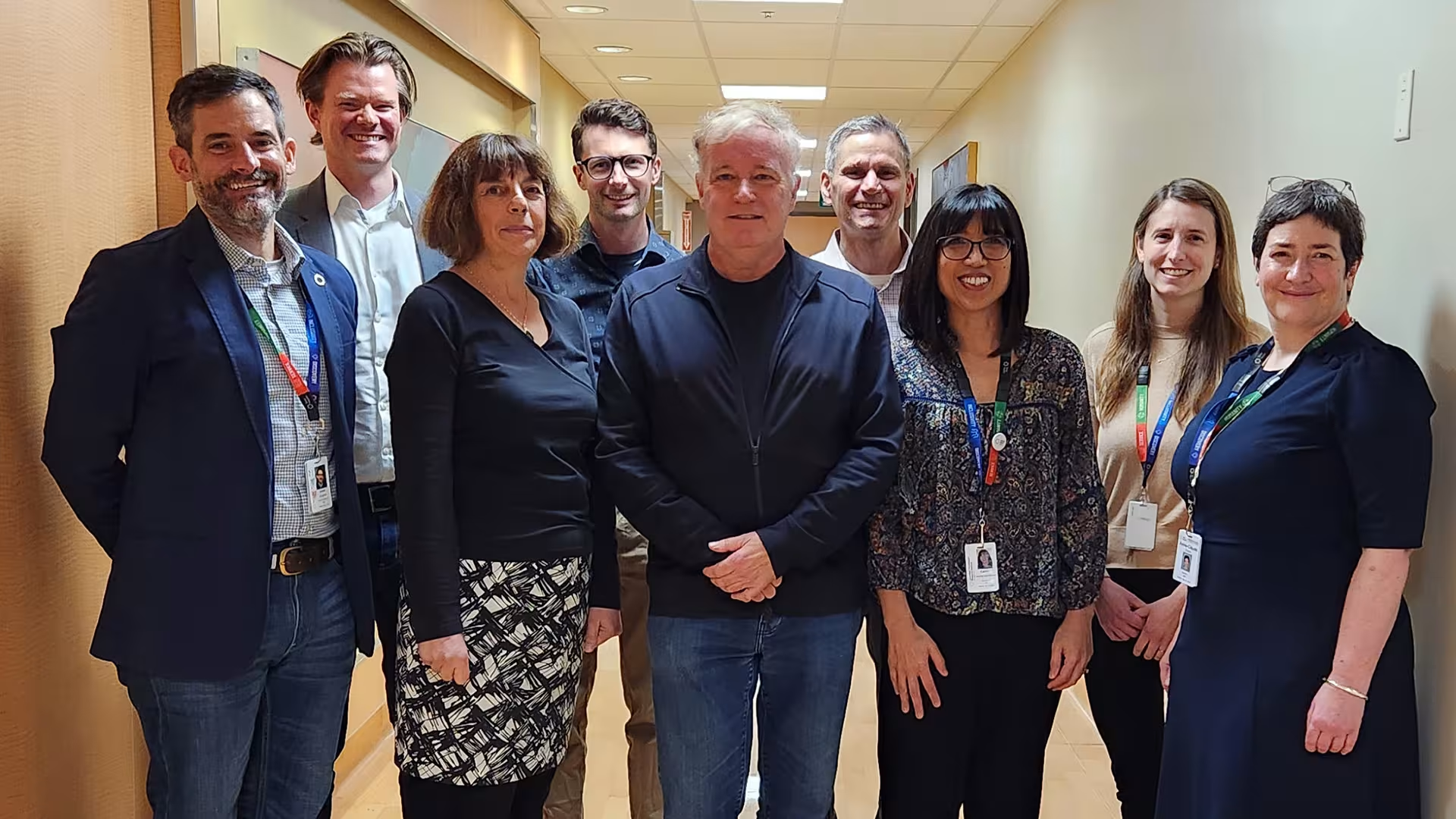
That work is now carried forward by an increasingly collaborative team. Alongside Drs. Schramek and Attisano, long-standing members and LTRI’s senior investigators Drs. Anne-Claude Gingras and Frank Sicheri continue to play key leadership roles, joined by a new generation of investigators – Drs. Hartland Jackson, Kieran Campbell and Diane Haakonsen from LTRI, and Dr. David Cescon from University Health Network. Together, the team brings expertise spanning cell biology, proteomics, structural biology, computational biology, cancer genomics, translational oncology and drug discovery, further strengthened through a close partnership with the Ontario Institute for Cancer Research (OICR), whose internationally recognized drug discovery expertise will help accelerate the translation of fundamental discoveries into promising new therapeutic strategies.
Over the next five years, the team will work together, across disciplines and institutions, to better understand cellular behaviour in breast and colorectal cancer, using cutting-edge technologies to create detailed maps of the Hippo pathway and the broader networks it communicates with.
“If successful, this research will shift cancer care from reactively treating existing tumour cells, to actively preventing cancer from adapting and escaping treatment,” says Dr. Schramek who holds the Canada Research Chair in Functional Cancer Genomics. “While our immediate focus is on breast and colorectal cancers, these therapeutic strategies have the potential to improve outcomes in a wide variety of other cancers.”
The team will then use these three-dimensional maps and previous drug discovery efforts to design and test new drug therapies that block the signals cancer cells use to shapeshift, grow and survive chemotherapy.
“Research of this calibre is made possible through a culture of collaboration, scientific excellence and long-term commitment," says Gary Newton, President and CEO of Sinai Health. "This renewed Terry Fox investment recognizes an exceptional team whose work exemplifies the impact that can be achieved when experts across disciplines come together to solve some of cancer's most challenging problems.”
The Terry Fox New Frontiers Program Project Grant is a long-standing program involving the best cancer researchers in Canada. These programs support Canadian research teams exploring new frontiers in biomedical, clinical and translational research, which are driving innovation in cancer prevention, diagnosis and treatment.
Adapted from Terry Fox Research Institute press release.
Related news and stories
View all News and Stories


