



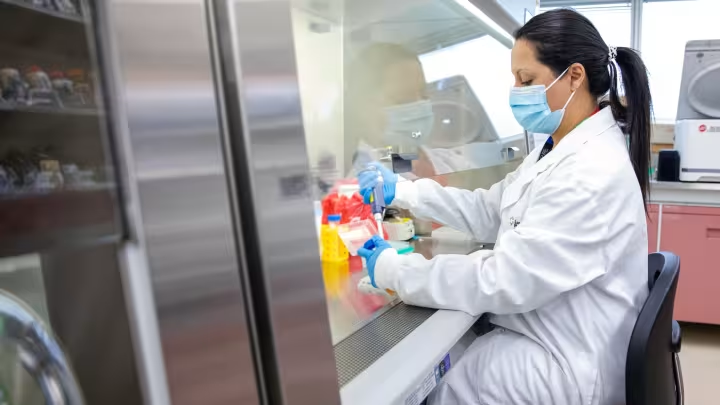
Dr. Alanna Weisman
Department of Medicine (Endocrinology), Mount Sinai Hospital
Closing the gap in type 1 diabetes care across Canada
Type 1 diabetes (T1D) affects about 300,000 Canadians and requires lifelong use of insulin to prevent life-threatening complications. Despite advances in treatment, many people with T1D are unable to achieve recommended blood sugar targets, leaving them at higher risk of complications and placing strain on the health system. Our research program focuses on understanding why this gap persists and how we can close it.
We use “big data” approaches to study outcomes for people with T1D across Canada. This work has revealed that most adults with T1D do not reach their treatment targets and that younger people, those with lower incomes, and those living in certain regions are especially disadvantaged. We also study the use of advanced diabetes technologies, such as continuous glucose monitors and automated insulin delivery systems, which can dramatically improve blood sugar control and quality of life. Our findings show that access to these technologies remains inequitable, particularly for socially disadvantaged adults.
By identifying where gaps exist and testing solutions to improve access, our research aims to inform health policy, reduce disparities and ensure that all people with T1D can benefit from life-changing treatments.

Email: [email protected]

Room 5-028, 60 Murray Street
Toronto, M5T 3L9

Publications: PubMed
Google Scholar: Alanna Weisman
ORCID: 0000-0003-3778-653X
Sinai Health Physician Profile: Alanna Weisman
- 2023–present; Assistant Professor (Status Only), University of Toronto, Institute of Health Policy, Management and Evaluation, Toronto
- 2020–present; Adjunct Scientist, Institute for Clinical Evaluative Sciences, Toronto
- 2020–present; Clinician Scientist, Mount Sinai Hospital, Toronto
- 2020–present; Assistant Professor, Endocrinology and Metabolism, Medicine, Faculty of Medicine, University of Toronto, Toronto
- PhD, Clinical Epidemiology & Health Care Research, University of Toronto, Toronto; 2015–2020
- FRCPC, Endocrinology & Metabolism, University of Toronto, Toronto; 2013–2015
- FRCPC, Internal Medicine, University of Toronto, Toronto; 2010–2013
- MD, Queen’s University, Kingston, Ontario; 2006–2010
- BSc, McMaster University, Hamilton, Ontario; 2003–2006
- 2025–2030 – Early Researcher Award, Government of Ontario
- 2024 – Banting & Best Diabetes Centre Diabetes Team of the Year Award
- 2023 – Breakthrough T1D Canada Emerging Clinician Researcher Award
- 2022 – Banting Research Foundation & Canadian Statistical Sciences Institute Ontario Discovery Award
- 2020 – Banting & Best Diabetes Centre Sunlife Financial New Investigator Award
EQUAT1D: Equitable uptake and appropriate use of diabetes technologies
The Equitable Uptake and Appropriate Use of Technologies for Adults with type 1 diabetes (EQUAT1D) is a project focused on reducing inequities in access to and use of diabetes technologies including insulin pumps, continuous glucose monitors (CGM) and automated insulin delivery systems among adults with type 1 diabetes (T1D) from socially disadvantaged communities. While diabetes technologies improve blood glucose management and enhance quality of life, their uptake remains inequitable, especially among people with low income, lower education, racial or ethnic minority backgrounds, or those living in rural settings.
The project has three phases:
Phase 1
Using population-based administrative health data from Ontario and Quebec and survey data from the BETTER Registry, we are quantifying disparities in technology initiation and evaluating whether their clinical benefits differ by social disadvantages.
Phase 2
This is a qualitative study using the Theoretical Domains Framework (TDF), where we are conducting semi-structured interviews with endocrinologists, diabetes educators and socially disadvantaged adults living with T1D to understand the barriers and facilitators to technology initiation and use.
Phase 3
Guided by a User Advisory Panel (UAP), we will co-design a behaviour change intervention targeting patients, providers, and health systems. More information can be found on our project website: www.equat1d.ca.
Increasing initiation of diabetes technologies among socially disadvantaged adults with type 1 diabetes through patient- and provider-level behaviour change
This project aims to evaluate the behaviour change intervention developed to increase initiation of diabetes technologies among socially disadvantaged adults with type 1 diabetes (T1D). Despite universal or partial public funding, inequities in uptake persist due to non-financial barriers such as provider bias, subjective prescribing criteria, administrative burden and limited patient education.
This project will address identified barriers through a theory-informed, user-centered design process. We will develop pilot patient- and provider-facing clinical tools and conduct a cluster randomized controlled feasibility trial in four diabetes clinics to test the intervention’s acceptability, feasibility and preliminary effectiveness outcomes.
We are always looking for motivated researchers to join our team.
Postdocs
Our research group is always interested in recruiting highly motivated postdoctoral fellows with a strong publication record in health services research. Please forward your CV, references and research interests to Alanna Weisman ([email protected]).
Graduate students
Our research group is part of the Institute of Health Policy, Management and Evaluation at U of T, which has a central admission committee. Identification of a supervisor prior to application is recommended though not necessary. Graduate students interested in doing an MSc or PhD should contact Alanna Weisman ([email protected]).
Summer students
Summer students are exclusively selected from successful applicants to the Research Training Center (RTC) at the Lunenfeld-Tanenbaum Research Institute. Applications are available online and need to be filled by February 28th of each year.
Notable publications
Diabetes, Obesity and Metabolism, 2025
Diabetes, Obesity and Metabolism, 2025
Diabetes, Obesity and Metabolism, 2024
Diabetes Technology & Therapeutics, 2024
Canadian Journal of Diabetes, 2024
Join our team
Visit our job board to see research positions.