



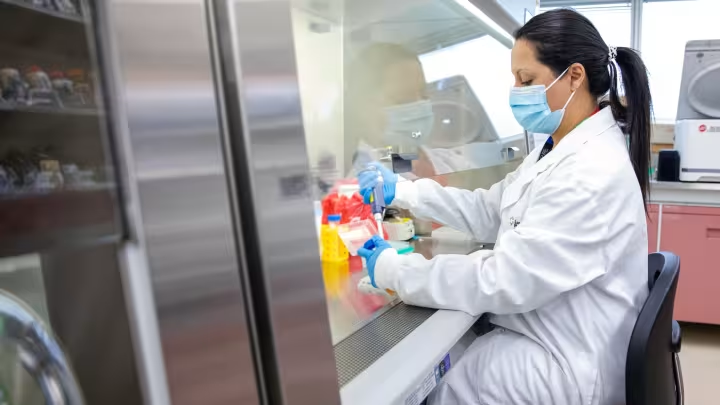
Dr. Bruce Perkins
Lead, Leadership Sinai Centre for Diabetes
Department of Medicine (Endocrinology), Mount Sinai Hospital
Advancing care for people living with type 1 diabetes
We study how to improve the lives of people living with type 1 diabetes across the lifespan, with a focus on predicting complications earlier, preventing diabetes-related harm, and advancing new treatments and technologies. Our work spans clinical trials, epidemiology, implementation science and translational research.
A major focus of our research is identifying early markers of diabetes complications such as kidney disease, nerve injury, cognitive decline, and cardiovascular disease, with the goal of intervening before irreversible damage occurs. We also study therapies and technologies designed to improve glucose management and reduce complications, including automated insulin delivery systems, continuous glucose and ketone monitoring, add-on-to-insulin medications to boost treatment efficacy and emerging immune and cell-based therapies.
Our team plays a leadership role in major international studies including the landmark Diabetes Control and Complications Trial / Epidemiology of Diabetes Interventions and Complications (DCCT/EDIC) Study, which continues to shape diabetes care worldwide. We are also committed to improving the safe implementation of new therapies and technologies through trials and aspects of implementation science.
Ultimately, our goal is to help people with type 1 diabetes live longer, healthier lives while reducing the burden of disease on individuals, families and healthcare systems.

Email: [email protected]

Room 5210, 60 Murray Street
Toronto, M5T 3L9

Publications: PubMed
Google Scholar: Bruce Perkins
Sinai Health Physician Profile: Bruce Perkins
- 2024–present; Chair, Diabetic Ketoacidosis Mitigation Committee, PERL (Preventing Ealry Renal function Loss) Consortium
- 2020–present; Vice Chair and Multiple Principal Investigator (MPI), Diabetes Control and Complications Trial / Epidemiology of Diabetes Interventions and Complications (DCCT/EDIC) Study
- 2020–present; Member, Senior Promotions Committee, Department of Medicine, University of Toronto, Toronto
- 2020–present; Chair, Ontario Continuous Glucose Monitoring Consultation Group
- 2018–present; The Sam and Judy Pencer Family Chair in Diabetes Clinical Research, University of Toronto, Toronto
- 2017–present; Professor of Medicine, Division of Endocrinology and Metabolism, Department of Medicine, University of Toronto, Toronto
- 2017–present; Professor, Institute of Health Policy, Management and Evaluation, University of Toronto, Toronto
- 2016–present; Co-Lead, Innovations in Type 1 Diabetes Goal Group, Diabetes Action Canada
- 2014–present; Executive Committee Member, Banting & Best Diabetes Centre
- 2011–present; Clinician-Scientist, Lunenfeld-Tanenbaum Research Institute, Sinai Health, Toronto
- 2011–present; Staff Physician, Leadership Sinai Centre for Diabetes, Mount Sinai Hospital, Sinai Health, Toronto
Former appointments
- 2003–2011; Assistant Professor, Department of Medicine, University of Toronto, Toronto
- 2003–2011; Clinician Investigator, University Health Network, Toronto
- William Randolph Hearst Research Fellow, Joslin Diabetes Center, Boston, MA, USA; 2001–2003
- Juvenile Diabetes Research Foundation International Research Fellowship, Joslin Diabetes Center, Harvard University, Boston, MA, USA; 2001–2003
- Clinical Endocrinology Fellowship, Longwood Area Integrated Program, Beth Israel Deaconess Medical Center, Brigham and Women’s Hospital and Joslin Diabetes Center, Harvard University, Boston, MA, USA; 1999–2002
- Master of Public Health (MPH), Epidemiology (Quantitative Methods), Harvard School of Public Health, Boston, MA, USA; 2000–2002
- Chief Medical Resident, The Toronto Hospital, Toronto; 1999
- Core Internal Medicine Residency, University of Toronto, Toronto; 1995–1998
- MD, Faculty of Medicine, University of Toronto, Toronto, Canada, 1991–1995
- 2022 – Dr. Gerald S. Wong Serice Award, Diabetes Canada
- 2015 – CDA/CIHR Young Scientist Award
Predicting and preventing complications in type 1 diabetes
Our research focuses on identifying the earliest signs of diabetes complications before irreversible damage occurs. Using long-term cohort studies and advanced biomarker approaches, we study predictors of kidney disease, nerve injury, cardiovascular disease, cognitive decline, and frailty in people with type 1 diabetes. A major component of this work occurs through leadership in the landmark DCCT/EDIC Study, one of the world’s most influential longitudinal diabetes studies. By identifying which individuals are at greatest risk and understanding the mechanisms underlying complications, we aim to develop strategies that allow earlier intervention and healthier aging with type 1 diabetes.
Adjunct-to-insulin medications for type 1 diabetes
Our research studies therapies used alongside insulin to improve glucose management and reduce complications in type 1 diabetes. A major focus has been sodium-glucose linked transporter (SGLT) inhibitors, including their effects on glucose control, kidney health, and metabolic outcomes. Through clinical trials and implementation research, we have also helped define safer strategies for preventing diabetic ketoacidosis (DKA), including ketone-monitoring and education approaches. We are increasingly interested in how adjunctive therapies can be combined with diabetes technologies and future disease-modifying therapies to improve outcomes and reduce treatment burden.
Diabetes technology and automated insulin delivery systems
We study how emerging diabetes technologies can improve glucose management and quality of life for people with type 1 diabetes. This includes automated insulin delivery systems (“artificial pancreas” systems), continuous glucose monitoring, and continuous ketone monitoring technologies. Our work evaluates both the physiological effects and real-world implementation of these systems, including how they can safely reduce hypoglycemia, improve glycemic outcomes, and lessen treatment burden. We are also interested in combining these technologies with adjunctive therapies to further improve outcomes.
Preventing diabetic ketoacidosis (DKA)
Diabetic ketoacidosis remains one of the most serious acute complications of type 1 diabetes. Our team is developing new approaches to predict and prevent DKA using clinical trial data, ketone monitoring strategies, and implementation science methods. Working closely with people living with diabetes and healthcare providers, we co-design educational and behavioral tools that support safer diabetes self-management. This work includes evaluating novel approaches such as continuous ketone monitoring and safer implementation of adjunctive medications including SGLT inhibitors.
Disease-modifying and cell-based therapies for type 1 diabetes
We are increasingly involved in studies aimed at changing the natural history of type 1 diabetes. This includes immune-modulatory therapies designed to preserve insulin-producing beta cells as well as emerging stem-cell and islet replacement approaches. Through collaborations across Toronto and international clinical trial networks, we aim to help translate promising therapies into safe and effective treatments for people living with type 1 diabetes.
We are always looking for motivated researchers to join our team.
Trainee opportunities
We maintain a small, highly collaborative research team and selectively recruit trainees whose interests align closely with our program, particularly clinical trainees with strengths or training in quantitative epidemiology, clinical research methods, and diabetes outcomes research.
Postdoctoral fellows
We selectively recruit postdoctoral fellows with interests in diabetes complications, clinical epidemiology, clinical trials, diabetes technology, and type 1 diabetes therapeutics.
Graduate students
Our research group is affiliated with the Department of Medicine and the Institute of Health Policy, Management and Evaluation at the University of Toronto.
Summer students
Because of the small size of our research team, summer student opportunities are limited and highly selective.
Interested trainees should forward their CV and research interests to Dr. Bruce Perkins.
Notable publications
Diabetes Care, 2025
Nature Medicine, 2022
Diabetes Care, 2022
Diabetes Care, 2021
Diabetes Care, 2018
Join our team
Visit our job board to see research positions.