




Dr. Carlo Ammendolia
Director, Spine Clinic and Spinal Stenosis Program, Rebecca MacDonald Centre for Arthritis and Autoimmune Diseases, Mount Sinai Hospital
Restoring mobility without surgery
Over a million people worldwide suffer from lumbar spinal stenosis (LSS), in which the spinal canal in the lower back narrows and compresses the nerves and blood vessels, and is a leading cause of pain, disability and loss of independence in adults over 65.
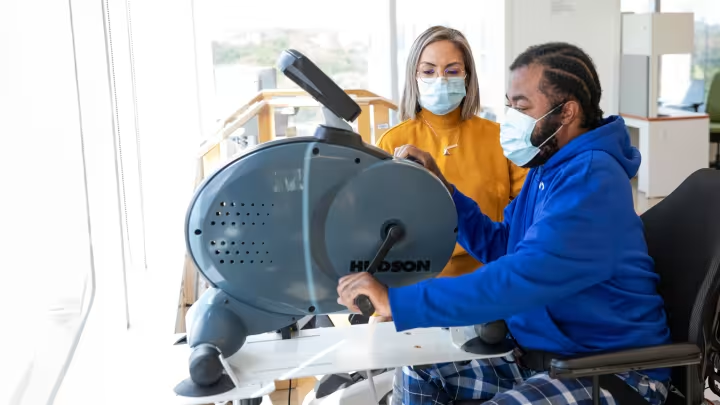
Fifteen years ago, surgery was often the only option but now, we’ve developed a better, non-surgical solution. At the Spine Clinic and Spinal Stenosis Program at Mount Sinai Hospital, we created the Spinemobility Boot Camp Program—a non-surgical treatment proven to significantly reduce pain and improve walking ability. It’s now considered the first-line treatment for LSS and has helped thousands of people worldwide regain mobility and quality of life.
To make this program more accessible, our team is developing a smartphone app that can reach people globally, including those in underserved and marginalized communities. We’re also expanding the Boot Camp model to treat other conditions like degenerative cervical myelopathy, affecting the bones and ligaments in the neck, cervical radiculopathy, affecting the nerves in the neck, sciatica, and hip and knee osteoarthritis.
Low back pain is the leading cause of disability worldwide and one of the most expensive health issues—often due to poor management. Our mission is to create and share effective, evidence-based care programs that empower people to take control of their health—without relying on surgery or drugs.

Email: [email protected]

Room 2-225, 60 Murray Street
Toronto, M5T 3L9

Publications: PubMed
Google Scholar: Carlo Ammendolia
ORCID: 0000-0003-4417-4961
LinkedIn: Carlo Ammendolia
Instagram: @spinemobility
- 2024–present; Clinician Scientist, Department of Anesthesiology and Pain Management and the Wasser Pain Management Centre, Mount Sinai Hospital, Sinai Health, Toronto
- 2013–present; Adjunct Professor, Graduate Education and Research, Canadian Memorial Chiropractic College, Toronto
- 2013–present; Assistant Professor, Department of Surgery, University of Toronto, Toronto
- 2011–present; Director, Spine Clinic and Spinal Stenosis Program, Mount Sinai Hospital, Sinai Health, Toronto
- 2011–present; Faculty, University of Toronto Spine Program, Faculty of Medicine, Department of Surgery, University of Toronto, Toronto
- 2007–present; Assistant Professor, Institute of Health Policy, Management and Evaluation (IHPME), University of Toronto, Toronto
- PhD, Clinical Evaluative Sciences, University of Toronto, Toronto; 2000–2005
- MSc, Clinical Epidemiology, University of Toronto, Toronto; 1996–1999
- BSc, Microbiology, University of Toronto, Toronto; 1975–1978
- 2022 – Top International Paper Award, Non-operative treatment for lumbar spinal stenosis with neurogenic claudication: an updated systematic review, oral presentation, North American Spine Society Conference, Chicago, IL, USA
- 2022 – University of Toronto’s Wightman-Berris Academy Individual Teaching Excellence Award.This award is given to exemplary teachers who have been nominated by their students and reflects the positive impact that he has had on students and their educational experience.
- 2021 – Distinguished Educator Award from Medical Education Mount Sinai Hospital selected by trainees (medical and chiropractic residents) for outstanding dedication and passion for teaching
- 2021 – The designation of “World Expert” in Spinal Stenosis by Expertscape based on the number of publications in this field in past 10 years
- 2021 – Dr. Michael Brickman Heart and Hands Award. Presented to the practising chiropractor who best embodies a generous and giving spirit (the heart) with the remarkable passion and education to chiropractic care.
- 2019 – Best Poster Award, First Prize, Does patient expectations impact outcomes in non-operative treatment of lumbar spinal stenosis?, EPIC World Federation of Chiropractic Conference, Berlin, Germany
- 2019 – Best Poster Award, Second Prize, Does duration of symptoms impact outcomes in non-operative treatment of lumbar spinal stenosis?, EPIC World Federation of Chiropractic Conference, Berlin, Germany
- 2017 – Professorship in Spine Award, Faculty of Medicine and University of Toronto Spine Program, Department of Surgery, University of Toronto, Toronto
- 2016 – Chiropractic Researcher of the Year Award, Canadian Chiropractic Association
- 2015 – Chiropractor of the Year Award, Ontario Chiropractic Association, Ontario, Canada
- 2014 – A Best Paper Award, Effectiveness of the Boot Camp Program for Degenerative Lumbar Spinal Stenosis: A retrospective study, Invited Presentation at the American Chiropractic Colleges Research Conference, Orlando, FL, USA
- 2013 – Chiropractic Researcher of the Year Award, Ontario Chiropractic Association, Ontario, Canada
Spinemobility’s boot camp app for lumbar spinal stenosis
A decade ago, surgery was the standard treatment for Lumbar Spinal Stenosis (LSS). Since then, Spinemobility developed the Boot Camp Program—a non-operative approach tested through clinical trials and long-term studies. Results showed significant, lasting benefits, and today the program is recognized globally as a first-line treatment, translated into eight languages.
Over the past two years, we’ve been digitizing the program into a mobile app. A Beta version has successfully completed usability testing, both as a companion to in-clinic care and as a standalone tool. We are now seeking funding for a feasibility study to launch a clinical trial.
LSS is a major cause of pain, disability and reduced independence in older adults, affecting an estimated 280 million older adults worldwide—a number expected to double in the next 30 years. The app aims to dramatically expand access to care, especially in underserved and remote communities, improving quality of life on a global scale.
Designed for ease of use and portability, the app includes:
- Video and photo-based exercise instructions
- Activity reminders and motivational messaging
- A reward system for progress
- Graphs tracking daily, weekly and monthly activity improvements, viewable by users and healthcare providers
This digital evolution of the Boot Camp Program represents a powerful step forward in accessible, evidence-based care for aging populations.
Rekai Health Centre’s spinal stenosis program: Empowering marginalized communities
We’re thrilled to announce new funding from the Rotary Club of Toronto, University of Toronto and Canadian Memorial Chiropractic College! These funds will support interviews and focus groups to better understand how spinal stenosis affects marginalized populations—and how we can tailor our Boot Camp Program to meet their unique needs.
Now in its second year, the Rekai Health Centre program trains interns annually to deliver non-operative care to underserved individuals. Our structured protocol gathers insights from participants to evaluate both short- and long-term outcomes. By expanding access to this evidence-based program, we’re helping improve mobility, independence and overall quality of life for those who need it most.
Boot camp for degenerative cervical myelopathy: A new frontier
We’ve developed a groundbreaking non-operative program for mild degenerative cervical myelopathy, combining exercise and education. With only one randomized trial comparing surgical and conservative care, we’re partnering with McMaster University to launch a feasibility study. If successful, it will pave the way for a multicentre clinical trial.
This condition—marked by spinal cord compression—can cause loss of dexterity, or fine motor skills, balance issues and disability. Our goal is to reduce the burden through accessible, self-directed, evidence-based care.
Building a global clinical registry
We’re collaborating with IT experts to create digital tools that track outcomes across all 11 Boot Camp Programs. This registry will help us refine treatments, personalize care and share insights with practitioners worldwide—driving innovation and impact.
Spinal stenosis belt: second-gen innovation
Our prototype belt aims to improve walking in lumbar spinal stenosis by optimizing spinal alignment. Early data is promising, but we’re refining comfort and usability. With potential for commercialization, this device could be a game-changer for mobility and independence.
We are always looking for motivated researchers to join our team.
Postdocs
Our research group is always interested in recruiting highly motivated postdoctoral fellows with a strong publication record in clinical musculoskeletal research. Please forward your CV, references and research interests to Dr. Carlo Ammendolia.
Graduate students
Our research group is part of the Department of Surgery and the Institute of Policy, Management and Evaluation at the Faculty of Medicine at the University of Toronto, which requires that a supervisor be identified before admission to the graduate program. Graduate students interested in doing a PhD in the laboratory/group should first contact Dr. Carlo Ammendolia directly.
Summer students
Summer students are exclusively selected from successful applicants to the Research Training Center (RTC) at the Lunenfeld-Tanenbaum Research Institute. Applications are available online and need to be filled by February 28th of each year
For researchers not affiliated with LTRI:
Summer students should contact Dr. Carlo Ammendolia.
Notable publications
Chiropractic & Manual Therapies, 2025
BMJ Open, 2022
PCORI, 2019
The Spine Journal, 2019
ACRM, 2018
Join our team
Visit our job board to see research positions.