


Dr. Frank Sicheri
Lunenfeld-Tanenbaum Research Institute
Molecular signals, switches and origins of disease
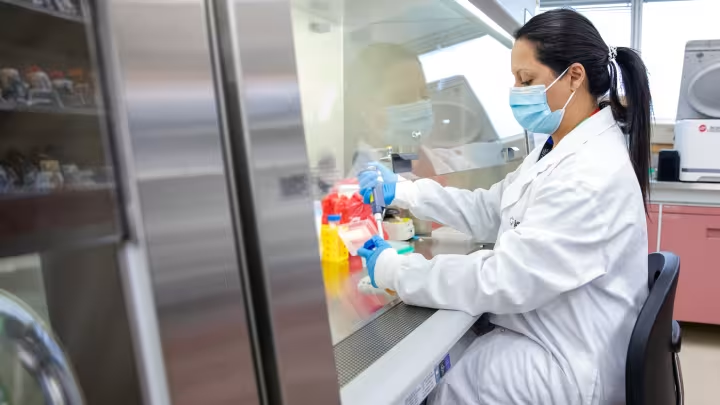
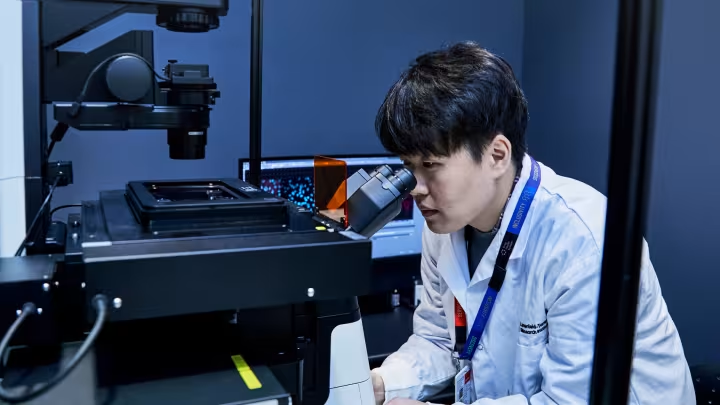
We study how cells use molecular switches to control growth, survival and repair, and how these switches fail in disease. Our laboratory focuses on signal transduction: the systems of proteins that receive information, relay it inside cells and trigger appropriate responses. We visualize these proteins in action using structural biology methods, including X-ray crystallography, protein NMR spectroscopy and cryo-electron microscopy, and combine these approaches with biochemical and molecular experiments.
Much of our work centres on protein kinases, which act as on/off switches in many cellular pathways, and on the ubiquitin-proteasome system, which controls when proteins are modified, redirected or destroyed. By determining how these molecules recognize partners, change shape and become dysregulated, we aim to explain the molecular origins of cancer and other diseases. These discoveries also create opportunities for therapy.
We work with collaborators in academia and in industry to design tool compounds, test whether difficult protein targets are druggable and build structure-guided platforms for developing more potent therapeutics. Our goal is to turn mechanistic insight into new strategies for treating human disease.

Email: [email protected]

Room 1090, 600 University Avenue
Toronto, M5G 1X5

Website: Sicheri Lab
Publications: PubMed
Google Scholar: Frank Sicheri
ORCID: 0000-0002-9824-2117
U of T Department of Biochemistry: Frank Sicheri
U of T Department of Molecular Genetics: Frank Sicheri
LinkedIn: Frank Sicheri
- 2011–present; Professor, Department of Biochemistry, University of Toronto, Toronto
- 2007–present; Professor, Department of Molecular Genetics, University of Toronto, Toronto
- 2004–present; Senior Investigator, Program in Systems Biology, Lunenfeld-Tanenbaum Research Institute, Sinai Health, Toronto
Former appointments
- 2016–2025; Co-founder and Consultant, Repare Therapeutics
- 2014–2017; Consultant, Nurix
- 2004–2007; Associate Professor, Department of Medical Genetics and Microbiology/Molecular and Medical Genetics, University of Toronto, Toronto
- 1998–2004; Assistant Professor, Department of Medical Genetics and Microbiology/Molecular and Medical Genetics, University of Toronto, Toronto
- 1998–2004; Investigator, Program in Molecular Biology and Cancer, Samuel Lunenfeld Research Institute, Mount Sinai Hospital, Toronto
- Postdoctoral fellow with Dr. John Kuriyan, Rockefeller University, New York, USA; 1995–1997
- PhD in Biochemistry with Dr. Daniel Yang, McMaster University, Hamilton, Canada; 1989–1995
- BSc, Honours Biochemistry, McMaster University, Hamilton, Canada; 1985–1989
- 2016–2023 – Canada Research Chair in Structural Biology of Signal Transduction
- 2016–2021 – Apotex Chair in Molecular Oncology, Sinai Health System
- 2011 – Fellow, Royal Society of Canada
- 2008 – Merck Frosst Prize, Canadian Society of Biochemistry and Molecular & Cellular Biology
- 2003 – Terry Fox Young Investigator Scholar, National Cancer Institute of Canada / Terry Fox Foundation
- 1999–2004 – National Cancer Institute of Canada / Canadian Cancer Society Research Scientist Scholar
- 1998 – Premier’s Research Excellence Award, Ontario Research and Development Challenge Fund
- 1998 – Canada Foundation for Innovation Researcher
- 1996–1998 – Human Frontier Science Program Postdoctoral Fellowship Award
- 1992–1995 – Ontario Graduate Scholarship, McMaster University
- 1988 – NSERC Undergraduate Industrial Award
Structural mechanisms of protein kinase signalling
Protein kinases are enzymes that act as molecular switches. They regulate many cell behaviours by adding phosphate groups to other proteins, but mutations or inappropriate activation can make these switches drive disease. We use structural biology, biochemistry and molecular approaches to understand how kinases turn on and off, how they recognize specific substrates and how they are controlled by other proteins. A major focus is the RAS-ERK pathway, including the RAF kinase family, where abnormal signalling is common in cancer. By visualizing the molecular states of these proteins, we aim to reveal regulatory mechanisms that can be exploited for better therapeutic design.
Induced proximity therapeutics for difficult-to-drug signalling proteins
Many disease-driving proteins are difficult to inhibit with conventional small molecules. We are developing induced-proximity strategies that use synthetic molecules to bring two proteins together in a controlled way. This approach can redirect cellular machinery to alter signalling, promote degradation or modulate activity. These studies combine structure-based drug design, inhibitor screening, medicinal chemistry and functional assays to create new chemical tools and therapeutic hypotheses.
We are always looking for motivated researchers to join our team.
Postdocs
Our research group is interested in recruiting highly motivated postdoctoral fellows with a strong publication record in structural biology, protein biochemistry, signal transduction, ubiquitin biology, chemical biology and structure-guided therapeutic discovery. Please forward your CV, references and research interests to Dr. Frank Sicheri.
Graduate students
Our research group is part of the Department of Molecular Genetics and the Department of Biochemistry at the Temerty Faculty of Medicine, University of Toronto. Graduate students interested in doing a PhD in the laboratory should apply through the relevant University of Toronto graduate program and contact Dr. Frank Sicheri to discuss research fit and potential rotation or supervision opportunities.
Notable publications
Nature Chemical Biology, 2026
Nature Communications, 2024
Nature Communications, 2024
Nature Structural & Molecular Biology, 2024
Join our team
Visit our job board to see research positions.