



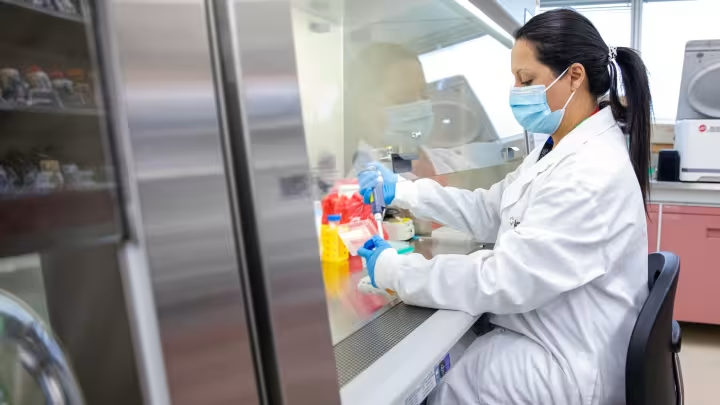
Dr. Irene Andrulis
Lunenfeld-Tanenbaum Research Institute
Co-Head, Fred A. Litwin Centre for Cancer Genetics, Sinai Health
Advancing breast cancer and sarcoma research
Our team conducts multi-disciplinary studies to identify molecular alterations that may play a role in cancer and to determine the clinical importance of these changes in human disease. The focus of the laboratory has been on sporadic and hereditary breast cancer and on adult bone and soft tissue sarcomas. We recruit and follow clinically large cohorts of participants who are willing to provide blood and/or tumour specimens for research studies. Our overall goal is to discover genetic characteristics in cancer that may be better indicators of clinical behaviour than current systems and may lead to novel approaches to treatment.
In a study of women with early-stage breast cancer, we identified genetic changes in tumours that distinguish patients who had a recurrence of their disease from those who remained disease free. To understand the molecular basis of hereditary breast cancer and the role of genetics and lifestyle factors in breast cancer risk, progression and outcome, we established the Ontario Familial Breast Cancer Registry, one of six sites in the Breast Cancer Family Registry.
Currently, a major area of interest for our group is the role of the tumour immune microenvironment in human breast cancer and sarcoma. Immune checkpoint therapy is a treatment option that leverages the immune system of the patient to enhance anti-tumour responses. Through our Sarcoma Research Program, we have been using high-throughput technologies to advance our understanding of tumour-immune cell interactions offering novel potential targets for therapy.

Email: [email protected]

Room 884, 600 University Avenue
Toronto, M5G 1X5

Website: Breast Cancer Family Registry
Publications: PubMed
ORCID: 0000-0002-4226-6435
- 1997–present; Professor, Department of Molecular Genetics, University of Toronto, Toronto
- 1997–present; Professor, Department of Lab Medicine and Pathobiology (cross- appointment), University of Toronto, Toronto
- 1997–present; Chair, Molecular Characterization Working Group, Breast Cancer Family Registry
- 1995–present; Senior Investigator, Lunenfeld-Tanenbaum Research Institute, Sinai Health, Toronto
Former appointments
- 2016–2019; External Advisory Board, SARC Sarcoma SPORE, USA
- 2011–2021; Anne and Max Tanenbaum Chair in Molecular Medicine, Sinai Health, Toronto
- 1995–2011; Director, Ontario Cancer Genetics Network
- 1991–1997; Associate Professor, Department of Molecular and Medical Genetics, University of Toronto, Toronto
- 1985–1991; Assistant Professor, Department of Molecular and Medical Genetics, University of Toronto, Toronto
- Postdoctoral fellowship, Department of Genetics, Hospital for Sick Children, Toronto; 1978–1982
- PhD in Molecular Biology and Biochemistry, University of California, Irvine, CA, USA; 1974–1978
- BA in Biology and Psychology, University of Pennsylvania, Philadelphia, PA, USA, 1973
- 2011–2021 – Anne and Max Tanenbaum Chair in Molecular Medicine, University of Toronto, Sinai Health
- 2018 – Oakdale Golf and Country Club Scientist in Cancer Research
- 2007 – Israel Cancer Research Fund Women of Action Scientific Honoree
- 1996 – Scotiabank Scientist
- 1995 – Canadian Breast Cancer Foundation Award - Ontario Chapter
- 1979–1982 – US National Institutes of Health Postdoctoral Fellowship
- 1975–1978 – US National Institutes of Health Predoctoral Fellowship
- 1969–1973 – University of Pennsylvania Undergraduate Scholarship
Investigation of the tumour immune microenvironment in human bone and soft tissue sarcoma
Our team has established unique collections of biospecimens from patients with bone and soft tissue sarcomas, with corresponding clinical data. Our team found that a subset of sarcomas contained tumour infiltrating lymphocytes (TILs) and expressed PD-L1, and that PD-L1 over-expression was associated with better survival for patients with untreated undifferentiated pleomorphic sarcoma and osteosarcoma (Wunder et al., 2020). Our group is studying the tumour immune microenvironment and investigating the mechanisms mediating immunologic responses through high throughput sequencing, immunohistochemistry and spatial profiling.
Molecular genetic studies on breast cancer susceptibility
The discovery of breast cancer susceptibility genes has played a major role in our understanding of the molecular basis of hereditary breast cancer. Our group, the Ontario site of the Breast Cancer Family Registry, participates in international consortia such as BCAC (Breast Cancer Association Consortia) and CIMBA (Consortium of Investigators of Modifiers of BRCA1/2) to determine the importance of mutations and variants in high and intermediate breast cancer risk genes (BCAC, 2021).
Studies on the tumour immune microenvironment in hereditary and sporadic breast cancer
Our team has been particularly interested in molecular and histopathological characterization of tumours from women with and without germline BRCA1 and BRCA2 mutations. We have identified differences in gene expression and the tumour immune microenvironment between BRCA1 and BRCA2-associated cancers and non-BRCA1 and BRCA2 associated cancers. We found that T-bet positive lymphocytes in the tumour microenvironment were associated with the basal subtype as well as morphologic features characteristic of an aggressive phenotype, yet T-bet positivity was associated with a good prognosis (Mulligan et al. 2016).
Follow-up studies are ongoing and suggest the importance of the presence and location of DC-LAMP positive dendritic cells in clinical outcome in hereditary and sporadic breast cancer. Our studies may help in better tailoring specific therapies including immunotherapies for subtypes of breast cancer.
Notable publications
Clinical Cancer Research, 2025
The New England Journal of Medicine, 2021
OncoImmunology, 2020
Cancer Immunology Research, 2016
Journal of Clinical Oncology, 1998
Join our team
Visit our job board to see research positions.