



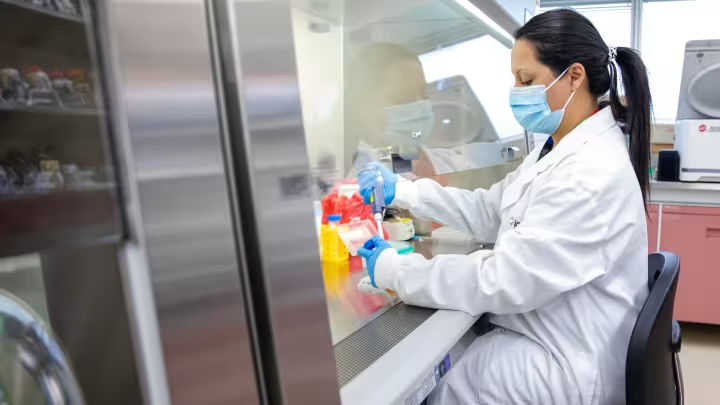
Dr. Kieran Campbell
Lunenfeld-Tanenbaum Research Institute
Machine learning approaches for single-cell cancer biology and drug discovery
We develop and apply state-of-the-art machine learning algorithms for single-cell, spatial and imaging datasets. We have specific interests in mapping how tumour genetics and its immediate surrounding environment in the body work together to shape its behaviour and influence how the disease progresses.
To answer these questions, we use machine learning models to predict what happens when genes, cells or drugs are changed. This helps us identify new biomarkers and discover potential drug targets. We collaborate with a broad range of researchers both in Toronto and further afield, working both on technology development as well as focussing on specific areas including cancer (pancreatic, sarcoma, prostate), transplant biology and immunology.

Email: [email protected]

Room 875, 600 University Avenue
Toronto, M5G 1X5

Website: Campbell Lab
Publications: PubMed
Google Scholar: Kieran Campbell
ORCID: 0000-0003-1981-5763
LinkedIn: Kieran Campbell
Bluesky: @kieranrcampbell.bsky.social
X: @kieranrcampbell
- 2026–present; Associate Professor, Departments of Molecular Genetics & Statistical Sciences, University of Toronto, Toronto
- 2020–present; Investigator, Lunenfeld-Tanenbaum Research Institute, Sinai Health, Toronto
- 2020–present; Faculty Affiliate, Vector Institute, Toronto
- 2020–present; Associate Faculty, Ontario Institute for Cancer Research, Toronto
Former appointments
- 2020–2026; Assistant Professor, Departments of Molecular Genetics & Statistical Sciences, University of Toronto, Toronto
- Banting postdoctoral fellowship at the Department of Statistics, University of British Columbia and Department of Molecular Oncology, BC Cancer Agency; 2017–2019
- PhD Computational Genomics, University of Oxford, Oxford, England; 2014–2017
- MPhil Computational Biology, University of Cambridge, Cambridge, England; 2013–2014
- BSc Mathematical Physics, University of Edinburgh, Edinburgh, Scotland; 2009–2013
- 2026 – New Investigator Award, Canadian Society for Molecular Biosciences
- 2025–2030 – Early Researcher Award, Government of Ontario
- 2021–2031 – Canada Research Chair in Machine Learning in Translational Biomedicine
Notable publications
Nature Communications, 2025
Nature Communications, 2025
Nature Communications, 2024
Cell Systems, 2021
Nature Methods, 2019
Join our team
Visit our job board to see research positions.