


Dr. Laurence Pelletier
Director, Nikon Center of Excellence
Co-Director, Network Biology Collaborative Centre
Lunenfeld-Tanenbaum Research Institute
Defining how centrosomes and cilia organize cell division, development and disease
We study how human cells build and use the centrosome and the cilium—organelles that organize the cell’s internal architecture, power cell division and control key signalling pathways. When these systems fail, the consequences range from brain disorders such as microcephaly to cancer and age‑related neurodegeneration.
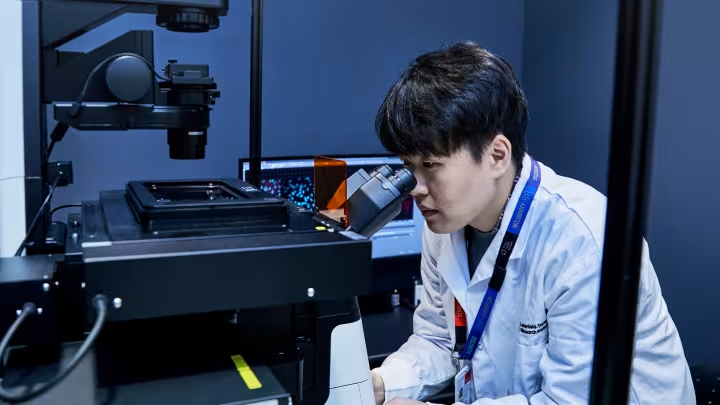
To tackle these problems, we combine functional genomics, proteomics, high‑resolution and AI‑enabled imaging and biochemistry to map the proteins and circuits that assemble the centrosome and drive mitosis – the process of cell division.
We also examine how centrosomes interact with cellular stress responses. This includes looking at how cells manage damaged proteins and form protective clumps called aggresomes. By doing this, we aim to understand why these aggresomes appear in disease and how cells recover from stressful conditions.
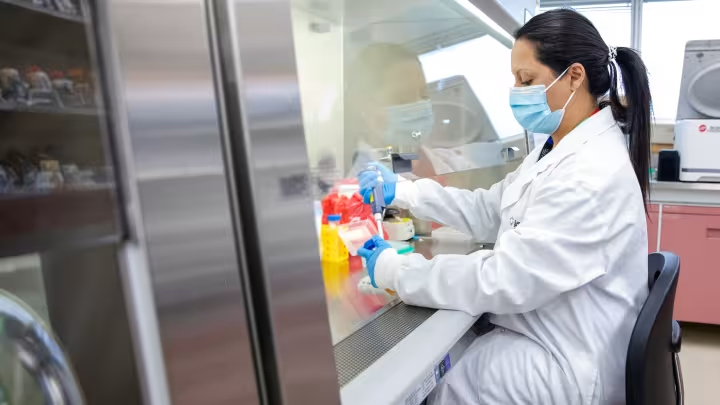
Method development is central to our work. We create and share tools—such as endogenous tagging platforms, which allow genes to be fluorescently tagged and expressed at their natural levels in cells, and automated imaging pipelines—that make it possible to test gene function at scale in realistic cell and organoid models. Working closely with teams across Sinai Health through the Nikon Center of Excellence and the Network Biology Collaborative Centre, we provide open access to advanced microscopes and high‑throughput screening, enabling collaborative discovery.
Our goal is to convert deep, mechanistic insight into practical benefits: better diagnostics and biomarkers, new entry points for therapy and robust training for the next generation of scientists.

Email: [email protected]

Room 1070, 600 University Avenue
Toronto, M5G 1X5

Website: Pelletier Lab
Google Scholar: Laurence Pelletier
ORCID: 0000-0003-1171-4618
Network Biology Collaborative Centre: Website
LinkedIn: Laurence Pelletier
X: Pelletier Lab
- 2022–present; Co-Director, Network Biology Collaborative Centre, Lunenfeld-Tanenbaum Research Institute, Sinai Health, Toronto
- 2021–present; Director, Nikon Centre of Excellence, Lunenfeld-Tanenbaum Research Institute, Sinai Health, Toronto
- 2016–present; Professor, Department of Molecular Genetics, University of Toronto, Toronto
- 2013–present; Senior Investigator, Lunenfeld-Tanenbaum Research Institute, Sinai Health, Toronto
- Postdoctoral Fellow with Dr. Tony Hyman, Max Planck Institute of Molecular Cell Biology & Genetics (MPI‑CBG), Dresden, Germany;
- PhD with Dr. Graham Warren, Cell Biology, Yale University School of Medicine, New Haven, CT, USA;
- MSc, Molecular Biology, Université de Montréal, Montreal, Canada;
- BSc, Microbiology & Immunology, Université de Montréal, Montreal, Canada;
- 2018–2032 – Canada Research Chair, Centrosome Biogenesis & Function
- 2016 – Robert H. Haynes Young Scientist Award in Genetics
- 2008–2013 – Terry Fox New Investigator Award
- 2009 – Ontario Early Researcher Award
- 2007 – HFSP Career Development Award
Building the centrosome and dividing the genome
We investigate how cells assemble the centrosome and organize the mitotic spindle to accurately segregate chromosomes. By combining endogenous protein tagging, live‑cell/super‑resolution imaging and perturbation screens, we map how pericentriolar material and microtubule‑associated complexes coordinate mitosis.
Why it matters: safer, more selective ways to target dividing cells and diagnose mitotic failure.
Centrosomes, cilia and signaling in development & disease
We study how centrosomes and primary cilia integrate signals (e.g., Wnt/PCP) that guide cell shape and movement.
Why it matters: aberrant signaling underlies congenital disorders and invasive cancer; understanding the nexus suggests new intervention points.
Proteostasis and the aggresome stress‑response pathway
We examine how stress‑induced protein aggregates are triaged at the centrosome/aggresome and how centriolar satellites and CP110‑module components support recovery from proteotoxic stress.
Why it matters: clarifies why aggregates form and persist, and how to restore cellular health.
Platforms: genome editing, AI imaging & high‑throughput screening
We build and disseminate tools—e.g., qTAG for endogenous tagging, multimodal high‑content imaging and AI‑based denoising/analysis—to accelerate discovery.
Why it matters: these platforms are shared through the Network Biology Collaborative Centre/Nikon CoE, empowering collaborative, reproducible science across Sinai Health.
We are always looking for motivated researchers to join our team.
Postdocs
Postdocs with strengths in cell biology, imaging, functional genomics or computational image analysis are encouraged to reach out.
Graduate students
Our research group is part of the Department of Molecular Genetics at the Temerty Faculty of Medicine, at U of T, which has a central admission committee and a rotation system. Graduate students interested in doing a PhD in the laboratory must first be accepted in the Department of Molecular Genetics.
Summer students
Summer students are exclusively selected from successful applicants to the Research Training Center (RTC) at the Lunenfeld-Tanenbaum Research Institute. Applications are available online and need to be filled by February 28th of each year.
Notable publications

The EMBO Journal, 2025

Nature Cell Biology, 2022


Nature Reviews Molecular Cell Biology, 2017

Cell, 2015
Join our team
Visit our job board to see research positions.