



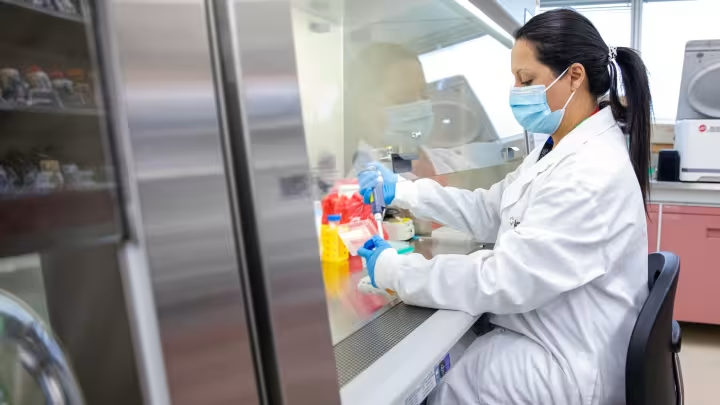
Dr. Laurent Briollais
Integrating genomics, clinical outcomes and epidemiology
Our lab, established in 2000, develops biostatistical methods and computational tools with applications in precision medicine. The advent of high-throughput genome sequencing and other genomic technologies has initiated an era of precision medicine where treatment and interventions need to be tailored to the molecular profiles of individuals. Translating genomic discoveries into clinically actionable decisions remains hindered by the lack of comprehensive statistical developments.
To bridge this gap, our research goal is to develop more comprehensive statistical methodologies that integrate genomic information, clinical outcomes and epidemiological data to inform more personalized prevention and treatment decisions. Our research program has been stimulated by the vibrant research environment at the Lunenfeld-Tanenbaum Research Institute, where we have developed invaluable collaborations with scientists from very diverse biomedical horizons, especially in relation to cancer research and child health initiatives.

Email: [email protected]

Room Number/Floor, 600 University Avenue
Toronto, M5G 1X5

Publications: PubMed
Google Scholar: Laurent Briollais
ORCID: 0000-0001-5741-9812
U of T Discover Research: Laurent Briollais
- 2022–present; Professor, Division of Biostatistics, Dalla Lana School of Public Health, University of Toronto, Toronto
- 2007–present; Senior Investigator, Lunenfeld-Tanenbaum Research Institute, Sinai Health, Toronto
Former appointments
- 2013–2021; Associate Professor, Division of Biostatistics, Dalla Lana School of Public Health, University of Toronto, Toronto
- 2000–2012; Assistant Professor, Division of Biostatistics, Dalla Lana School of Public Health, University of Toronto, Toronto
- 2000–2006; Investigator, Lunenfeld-Tanenbaum Research Institute, Sinai Health, Toronto
- Head of the Martinique Association for Cancer Research, Martinique, France;
- PhD, National Institute of Health and Medical Research, Paris, France; 1994–1998
- MSc, National Institute of Health and Medical Research, Paris, France; 1993–1994
- BSc, National Institute of Statistics and Economy, Paris, France, 1988–1990
Novel methodological approaches for cancer clinical trials in the era of personalized medicine
Cancer is the leading cause of death in Canada, responsible for just over one in four deaths. Its burden is anticipated to grow over the next decades due to the rapid aging of the general population. It is now recognized that the way we approach the understanding, diagnosis, and treatment of cancer is rapidly changing.
Emerging technologies in genomics, epigenomics, proteomics, nanotechnology, molecular diagnostics and imaging are enhancing our understanding of disease mechanisms and response to treatment. This opens the door to a new era characterized by a more personalized system of predictive, preventive and precision cancer treatment that can be tailored to a specific subgroup of patients or even to a specific individual.
The overall goal of this project is to provide a more comprehensive methodological framework that integrate genomic information, longitudinal tumor dynamics, and clinical data to optimize personalized medicine with application to ongoing clinical trials on pancreatic cancer. Our project is at the intersection of biostatistics, genomics and pharmaco-genomics. It has the potentials to enhance method developments for cancer risk predictions of cancer patients.
This work has also strong clinical implications since new information on genetic and genomic factors could be integrated into prediction models of clinical outcomes and lead to a more personalized treatment and managements of cancer patients.
Prediction models for hereditary cancer syndromes
The prediction ability of most existing risk prediction models for hereditary breast ovarian cancer, familial colorectal cancer and other familial cancer syndromes is usually relatively modest and have a large discrepancy in determining high-risk individuals who might benefit from intensive screening/interventions, which make their clinical utility questionable. Given their importance for genetic counseling and clinical management of high-risk patients, we plan to extend these risk prediction models.
This work includes several key methodological developments:
1) Model and predict the specific risks of cancer events in the presence of competing risks (death from other causes) in families.
2) Incorporate information on family history of cancers and polygenic risk score (PRS).
3) Account for complex time-dependent effects of prophylactic surgery, screening events and other risk factors.
4) Perform dynamic risk predictions of cancer risks in families (ie, updated each time new information on a patient and/or on his/her relatives is collected).
5) Implement a clinic-based assessment tool for cancer risk prediction in families using a web-based platform.
Specific applications of these new developments will be performed through the on-going collaborations with the Breast Cancer Family Registry and Colon Cancer Family Registry. The resulting outcomes of this research will generate enhanced risk prediction models applicable to a wide range of familial cancer syndromes that can impact clinical decisions.
Searching for new cancer predisposition genes and their causal rare variant determinants in large-scale sequencing studies
Next generation sequencing technologies (NGSs) held the promise that additional cancer predisposition genes (CPGs) could be identified. Yet, recent applications of these technologies in population-based studies have had limited success identifying new germline pathogenic variants (PVs).
The specific objectives of this research are:
1) Elucidate the genomic signature of germline rare variants of oncogenes and tumor suppressor genes based on TCGA data.
2) Identify new CPGs and causal germline rare variants from large germline sequencing studies.
3) Validate the newly discovered CPGs with in-vivo CRISPR screening methodology and the new causal germline variants through proteomic analyses.
We plan to develop a unique statistical and computational framework for gene-based analysis (burden-type test) of causal rare variant identification through Bayesian analysis. We will leverage several large whole-genome sequencing resources such as UK Biobank, all of US and TCGA for new CPGs and causal variant identification.
This research will provide a novel “hypothesis-driven” approach for CPGs and causal PVs discovery in large-scale sequencing initiatives. It could have important health impact by improving early detection of cancer in unaffected individuals carrying germline predisposing RVs as well as targeted therapies for those who already developed cancers based on their germline and somatic profiles.
We are always looking for motivated researchers to join our team.
Postdocs
Our research group is always interested in recruiting highly motivated postdoctoral fellows with a strong publication record in Biostatistics or Statistical Genetics. Please forward your CV, references and research interests to Dr. Briollais.
Graduate students
Our research group is part of the Division of Biostatistics, Dalla Lana School of Public Health at U of T, which has a central admission committee and a rotation system. Graduate students interested in doing a PhD in the laboratory must first be accepted in the Division of Biostatistics.
Summer students
Summer students are exclusively selected from successful applicants to the Research Training Center (RTC) at the Lunenfeld-Tanenbaum Research Institute. Applications are available online and need to be filled by February 28th of each year.
Notable publications

Biometrical Journal, 2023

Journal of the National Cancer Institute, 2023

The Annals of Applied Statistics, 2023

Biometrics, 2021

JAMA Oncology, 2021
Join our team
Visit our job board to see research positions.