


Dr. Mei Zhen
Lunenfeld-Tanenbaum Research Institute
Neural circuit development and function
We study how neural circuits are built, how they compute information, and how they derive adaptive behavioural responses. We learn primarily from a compact nervous system of a small invertebrate C. elegans and complement these fundamental insights with studies of the rodent neurons and neural circuits.
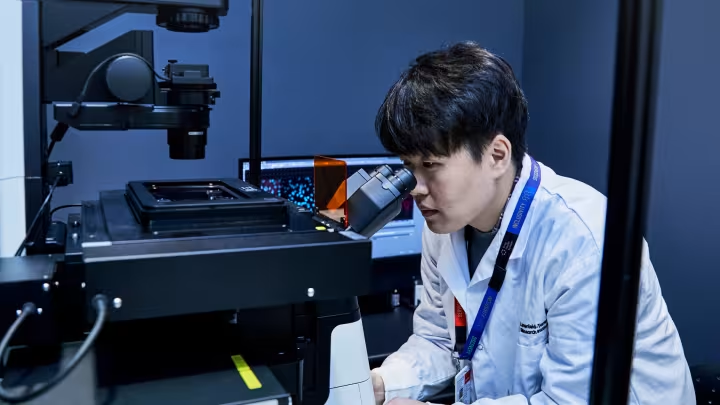
Using electron microscopy, we have mapped full synaptic wiring of C. elegans brain across postembryonic development. We have discovered the developmental order of circuit maturation and revealed that even genetically identical individuals develop significant differences in their brain wiring.
We further apply calcium imaging, electrical recordings, and behavioural studies to understand how these emerging circuits support the animal’s behaviours. Through these studies, we aim to identify environment and genetic factors that influence the structural and functional maturation of developing neural circuitry.
Lastly, our research makes real life impact. Through our studies in C. elegans, rodents and human neurons derived from stem cells, we identified an ion channel complex that controls how neurons fire, and its dysfunction causes developmental disorders. We are working on treatments for this disorder.

Email: [email protected]

Room 870, 600 University Avenue
Toronto, M5G 1X5

Website: Zhen Lab
Publications: PubMed
Google Scholar: Mei Zhen
ORCID: 0000-0003-0086-9622
X: @zhenlab_Toronto
- 2025–present; Editor, eLife
- 2023–present; Advisory Board Member, Channeling Hope Foundation
- 2020–present; Visiting scholar, Department of Physics, Harvard University, Cambridge, MA, USA
- 2018–present; Advisory Board Member, the Wormbase
- 2018–present; Co-Director, the Nanoscale Biomedical Imaging Facility, Sinai Health and the Hospital for Sick Children, Toronto
- 2012–present; Professor, Department of Molecular Genetics, University of Toronto, Toronto
- 2006–present; Senior Scientist, Lunenfeld-Tanenbaum Research Institute, Sinai Health
Former appointments
- 2006–2012; Associate Professor, Department of Molecular Genetics, University of Toronto, Toronto
- 2001–2006; Assistant Professor, Department of Molecular Genetics, University of Toronto, Toronto
- 2001–2006; Scientist, Lunenfeld-Tanenbaum Research Institute, Sinai Health, Toronto
- Post-doctoral fellow with Dr. Yish Jin, Neuroscience, University of California, Santa Cruz, Santa Cruz, USA; 1996–2000
- PhD in Biochemistry with Dr. Peter Candido, University of British Columbia, Vancouver, Canada; 1990–1995
- BSc in Biochemistry, Wuhan University, Wuhan, China; 1986–1990
- 2025 – Fellow, Royal Society of Canada
- 2024 – The EMBL Visiting Fellow
- 2023–2028 – Fellow, Canadian Institute for Advanced Research
- 2018–2032 – Canada Research Chair in Neuroscience
- 2001–2011 – Canada Research Chair in Neuroscience
- 2013 – Fellow, Radcliffe Institute for Advanced Study
- 2008 – Fellow, France Mobility Program in Science and Technology
- 2007–2011 – Early Researcher Award, Ontario Ministry of Research and Innovation
- 2007–2011 – EJLB Scholar, EJLB Foundation
- 2006–2007 – Petro Canada Young Innovator Award
- 1996–1998 – Post-doctoral Fellow, Human Frontier Science Foundation
- 1991–1995 – University Graduate Fellowship, University of British Columbia
Multi-scale connectomics and environmentally induced remodeling of wiring
The first project examines how early life sensory experience affects the neural circuit development, across the molecular, cellular and functional level. Connectome refers to the entire ensemble of synaptic wiring of the brain. Differences in synaptic wiring underlie plasticity, adaption and evolution in changing environments1.
C. elegans offers an ideal platform2 to examine and compare wiring differences of the entire nervous system3. Using high-throughput electron microscopy, we reconstructed the C. elegans connectome and identified a group of neurons that underlie sensory-input-dependent remodeling.
Our ongoing work aims to develop and apply molecular mapping by automated electron microscopy, functional calcium imaging and cell-specific genomics to reveal the developmental principles, consequences and mechanisms of circuit plasticity.
Specifically, we are addressing these questions:
1) What is the molecular composition of the wiring network?
2) What is the functional consequence of these wiring changes?
3) What are the computational units of this neural system?
These projects require researchers and trainees with strong interest in computational biology and imaging processing. Those with applied math, physics or engineering background are especially encouraged to apply.
References
- C. Darwin. On the Origin of Species by Means of Natural Selection, or the Preservation of Favoured Races in the Struggle for Life. Br. Foreign Medico-Chirurgical Rev. 25, 367 (1859).
- Witvliet, D. et al. Connectomes across development reveal principles of brain maturation in C. elegans. Nature (2021).
- Wang et al (2026 in preparation). Developmental strategy of C. elegans wiring maturation.
How neuronal excitability affects the structural and functional maturation of cerebellum circuitry
We study how the mouse cerebellar circuit controls motor balance and motor learning, and how a human pathological mutation, which changes the membrane property of the cerebellar neurons disrupts its developmental maturation using electrophysiology, functional recording and RNA-sequencing.
Na+ leak currents is a key determinant of neuron’s excitability1. Previous work from our group discovered the channel that conducts this current.2,3 It is comprised of four subunits: the pore forming subunit (NALCN), two accessory units (UNC79 and UNC80) and the ER delivery unit (NLF/FAM). These subunits are conserved from invertebrates to man4.
In 2005, we identified the first case of CLIFADD, a neurodevelopmental disorder caused by a gain-of-function mutation (R1181Q) in this channel.5 CLIFADD patients exhibit intellectual disability, episodic and persistent ataxia and arthrogryposis. We established a mouse model that conditionally expresses R1181Q in the endogenous loci and discovered by on slice whole-cell recording that this mutation dampens the high frequency firing of the Purkinje cells of the cerebellum, which may directly reduce the circuitry’s functional output.
Our ongoing work aims to understand the pathological effect at the circuit level and seek potential intervention of the disorder by targeting this channel conductance in vivo and in vitro.
We are recruiting trainees who are interested in electrophysiology, optical imaging or systems neuroscience to address:
1) The functional and behavioural analyses of R1181Q mouse brain.
2) Intervention of the pathological effect of the mutation in the mouse model.
References
- Hille, B. (2001). Ion Channels of Excitable Membranes.
- Yeh, E. et al. (2008). A putative cation channel, NCA-1, and a novel protein, UNC-80, transmit neuronal activity in C. elegans. PLoS Biol 6, e55.
- Xie, L. (2013). NLF-1 delivers a sodium leak channel to regulate neuronal excitability and modulate rhythmic locomotion. Neuron 77, 1069-1082.
- Kschonsak et al. (2020) Structure of the human sodium leak channel NALCN. Nature 587, 313–318.
- Aoyagi K., et al. (2015). A Gain-of-Function Mutation in NALCN in a Child with Intellectual Disability, Ataxia, and Arthrogryposis. Hum Mutat 36, 753-757.
- Du, T. et al. (2026; in preparation). A CLIFADD Gain-of-Function Mutation in NALCN decreases Purkinje neuron activity.
We are always looking for innovative and motivated researchers to join our team.
Postdocs
Our research group is always interested in recruiting highly motivated postdoctoral fellows with a strong publication record in systems and developmental neuroscience. Please forward your CV, references and research interests to Mei Zhen.
Graduate students
Our research group admits PhD students as part of the graduate program at the Department of Molecular Genetics, and the Department of Physiology at the University of Toronto.
Both departments have a central admission committee. Graduate students interested in doing a PhD in the laboratory must first be accepted in either department.
For the molecular genetics department, there is a rotation system. Upon receiving official admission from the department, students who are interested in pursuing PhD in the laboratories should send request emails the group (Mei Zhen) to discuss rotation option.
For the physiology department, which requires that a supervisor be identified before the official admission to the graduate program, graduate students interested in doing a PhD in the laboratory should first contact the group (Mei Zhen) to discuss directly prior to submitting the application to the department.
Undergraduate students
For researchers not affiliated with LTRI: We offer Workstudy, ROP, PEY Co-op, DSI, and summer undergraduate assistant positions. Those interested should contact Mei Zhen directly.
For researchers affiliated with LTRI: Summer research students are exclusively selected from successful applicants to the Research Training Center (RTC) at the Lunenfeld-Tanenbaum Research Institute. Applications are available online and need to be filled by February 28th of each year.
Notable publications

Science Advances, 2024


Neuron, 2013

Neuron, 2011
Join our team
Visit our job board to see research positions.