



Dr. Miguel Ramalho-Santos
Lunenfeld-Tanenbaum Research Institute
Stem cells, development and disease
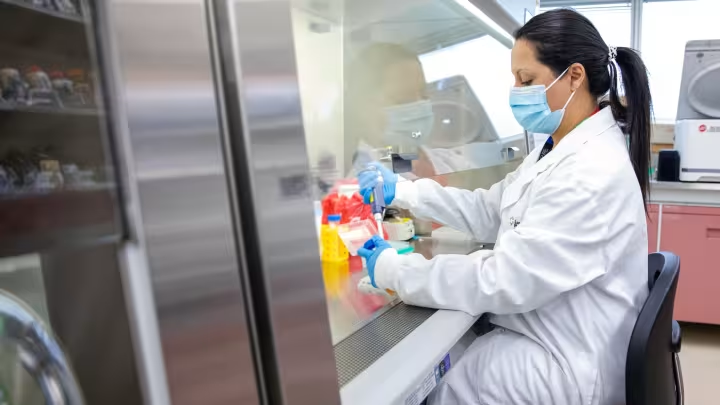
Our lab studies how early life begins, focusing on stem cells, which give rise to all cells in the body. We have discovered important systems that control how these cells grow and multiply to form a mammalian embryo.
One key finding is that embryonic stem cells have a unique way of turning many genes at once, a process known as hypertranscription, which helps them multiply quickly. We identified molecular factors that sustain this state and found that the same process happens in adult stem cells, which help maintain and regenerate organs throughout life. We also discovered a mechanism that allows the mammalian embryo to “pause” its development and enter a reversible state of suspended animation, or dormancy, during which cells cease dividing. Both hypertranscription and pausing also happen in cancer, which opens up new possibilities for understanding and treating disease.
We have also shown that genetic elements known as transposons, typically seen as harmful for our genome, can actually be beneficial and help organize the cell’s nucleus during early development. In parallel, we found that mammalian embryos, rather than being insulated from the external world, are in fact highly sensitive to their environment, including factors such as vitamin C, nutrients and maternal stress, which can influence how they develop. We continue to explore how these environmental signals interact with the embryo’s genetic and molecular systems shaping development and potentially influencing disease risk in adulthood.

Email: [email protected]

Room 6-1016-2, 25 Orde Street
Toronto, M5T 3H7

Website: Santos Lab
Publications: PubMed
Google Scholar: Miguel Ramalho-Santos
ORCID: 0000-0003-0177-5556
Bluesky: @mrsantos.bsky.social
- 2019–present; Professor, Department of Molecular Genetics, Faculty of Medicine, University of Toronto, Toronto
- 2018–present; Senior Investigator, Lunenfeld-Tanenbaum Research Institute, Sinai Health, Toronto
Former appointments
- 2018–2019; Associate Professor, Department of Molecular Genetics, Faculty of Medicine, University of Toronto, Toronto
- 2013–2018; Associate Professor, Obstetrics and Gynecology and Pathology, Centers for Regeneration Medicine and Reproductive Sciences, Diabetes Center, Og/Gyn and Pathology, School of Medicine, University of California, San Francisco, CA, USA
- 2006–2018; Co-Director, Lentiviral Core Facility, Diabetes and Endocrinology Research Center Diabetes Center, School of Medicine, University of California, San Francisco, CA, USA
- 2007–2013; Assistant Professor, Obstetrics and Gynecology and Pathology, Centers for Regeneration Medicine and Reproductive Sciences, Diabetes Center, Ob/Gyn and Pathology, School of Medicine, University of California, San Francisco, CA, USA
- UCSF Fellow, Developmental and Stem Cell Biology Program, Biochemistry and Biophysics, School of Medicine, University of California, San Francisco, CA, USA; 2003–2007
- Post-doctorate in Developmental Biology, Harvard University, Cambridge, MA, USA; 2002–2003
- PhD in Biochemistry, Harvard University, Cambridge, Massachusetts, MA, USA; 1997–2002
- MSc in Cellular and Molecular Biology, University of Coimbra, Coimbra, Portugal; 1995–1997
- BSc in Biology (Zoology), University of Coimbra, Coimbra, Portugal; 1990–1995
- 2025 – Anne and Max Tanenbaum Chair in Molecular Medicine Mount Sinai Hospital
- 2017 – Canada 150 Research Chair in Developmental Epigenetics Government of Canada
- 2016 – Royan International Research Award in Reproductive Genetics Royan Institute, Tehran, Iran
- 2008 – NIH Director's New Innovator Award NIH Director's Office, USA
- 2004 – Champion for Diversity University of California, San Francisco
- 1997 – Fellowship for PhD Abroad, Ministry for Science and Technology, Portugal
Stem cell hypertranscription
The part of the genome that is transcribed into RNA is called the transcriptome. The general assumption is that the overall level of the transcriptome does not change much between different cell types. However, we have found that this assumption is incorrect, notably during development, in stem cells, and in many cancers.
The origin of our studies on hypertranscription can be traced to Miguel’s PhD work on stem cell transcriptomics (Ramalho-Santos, Science, 2002, Kim, Stem Cell Reports, 2025). Hypertranscription, a global amplification of the transcriptome, has remained largely undetected due to limitations that we have helped overcome (Percharde, Dev Cell, 2017, Kim, Trends in Genetics, 2024). We found that hypertranscription is critical for the growth of pluripotent cells in early embryos and for the expansion of hematopoietic stem cells (Percharde, Cell Rep, 2017, Guzman-Ayala, Development, 2015, Koh Proc, Natl Acad Sci USA, 2015).
We showed that the chromatin remodeler Chd1 is an essential regulator of open chromatin and hypertranscription in embryonic stem cells (Gaspar-Maia, Nature, 2009, Guzman-Ayala, Development, 2015) and that it acts to promote repair of DNA breaks (Bulut-Karslioglu, Nature Communications, 2021). We developed methods to detect hypertranscription in single-cell RNA-seq data, and found that hypertranscription is pervasive in stem/progenitor cells across all major adult organs (Kim, Cell Reports, 2023). Moreover, we showed that human CHD1 is required for transcriptional output and tumour formation driven by the MYC oncogene in a breast cancer model (Cho, Oncogene, 2026). We continue to explore the molecular mechanisms and roles of hypertranscription.
Developmental dormancy
Cells and organisms from across all kingdoms of the tree of life can enter dormancy to survive challenging environmental conditions, and this is thought to have been central to the evolution of life on Earth. Dormancy can occur during embryonic development, in adult stem cells and in hibernating species. Despite its broad relevance, dormancy remains poorly understood. We have been studying dormancy in early mouse development. We discovered that dormancy can be induced in mouse embryonic stem cells and blastocysts, by inhibition of mTor, a kinase that is a central regulator of growth (Bulut-Karslioglu Nature 2016, Bulut-Karslioglu, Cell Stem Cell, 2018).
The ability to reversibly suspend the development of a mammal in the laboratory, and to mimic such developmental dormancy in embryonic stem cells, offers a tractable model to dissect a number of fascinating questions. We showed that m6A RNA methylation mediated by METTL3 is critical to maintain the transcriptionally suppressed state of dormancy by destabilization of mRNAs of growth promoting factors (Collignon, Nature Cell Biology, 2023). In parallel, we found that TGFbeta signaling via NODAL and SMAD2 is essential for dormancy by transcriptionally regulating lipid metabolism (Furlan, bioRxiv, 2025).
Working with collaborators in Toronto, we have found that cancer cells highjack the same molecular and cellular pathways of diapause to survive chemotherapy in a dormant state so that they can later regrow tumours (Rehman, Cell, 2021). The results point to new strategies to target these dormant cancer cells. We are exploring new regulators of the entry into and exit from developmental dormancy.
Transposons in development
Unique protein-coding genes occupy only a minor fraction (~1.5 per cent) of our genome. About half of the mouse and human genomes is comprised of Transposable Elements (TEs), which are sequences capable of moving to different locations in the genome. While TEs are generally assumed to be parasitic elements detrimental to genome integrity, they are a major source of novelty during evolution and can have beneficial roles during development (Percharde, Bioessays, 2020).
We found that RNA from mouse LINE1 orchestrates the progression of totipotent cells at the 2-cell stage towards pluripotent cells of the blastocyst. LINE1 RNA does this by partnering with the protein Nucleolin to regulate the expression of ribosomal RNA and re repress the 2-cell program (Percharde, Cell, 2018). Despite independent evolution of transposons in different mammalian lineages, we found that LINE1 plays a remarkably conserved role in human embryonic stem cells. LINE1 RNA promotes maintenance of genomic architecture of the nucleolus (Ataei, Genes and Development, 2024) and prevents developmental reversion to the human 8-cell state, the equivalent of the mouse 2-cell state (Zhang Developmental Cell 2024).
Thus, LINE1 is a key orchestrator of early embryogenesis and pluripotency. Moreover, we found that another type of repeat elements, the Alpha Satellite Repeat (ALR), is expressed in naïve human embryonic stem cells, maintains the perinucleolar compartment, which was thought to only exist in cancer cells, and regulates ribosomal RNA synthesis (Mittal, Genes and Development, 2026). We continue to explore novel roles for TE and repeat elements in developmental transitions.
Environment-epigenome-development
Developmental and stem cell biologists often assume that development is a process hardwired in the genome and insulated from environmental influence. However, a growing body of evidence shows that changes in environmental factors during pregnancy may affect developmental trajectories and program disease propensity in the progeny. The mechanisms that underlie the environmental modulation of developmental and stem cell biology remain largely unknown.
We discovered that the essential nutrient Vitamin C impacts the transcriptional and epigenetic state of cells in remarkable ways by acting as a specific co-factor for Tet enzymes and greatly enhancing DNA demethylation (Blaschke, Nature, 2013). Using mouse models, we went on to show that deficiency in dietary Vitamin C alters the epigenetic state and function of the fetal germline in vivo, recapitulating the Tet1 mutation, disrupting meiosis, and leading to sub-fertility in adulthood (Ditroia, Nature, 2019). Given that deficiencies in the activity of Tets have been causally linked to several types of cancer, our work contributed to a renewed interest in Vitamin C in cancer therapies.
We are dissecting the impact of a variety of environmental stressors during gestation on epigenetic states in fetal cells and physiological outcomes into adulthood and across generations. These ongoing projects paint a picture of the mammalian embryo being highly attuned to variations in environmental factors and capable of discriminating their nature at the molecular, developmental and physiological levels. These findings have implications for our understanding of intergenerational programming of disease, particularly in the context of rising environmental contamination and the ongoing climate crisis.
We are always looking for motivated researchers to join our team.
Postdocs
Our research group is always interested in recruiting highly motivated and creative postdoctoral fellows from diverse fields. Please forward your CV, the contact of 3 references and a cover letter explaining why you are interested in our lab to [email protected].
Graduate students
Our research group is part of the Department of Molecular Genetics, at the Temerty Faculty of Medicine at University of Toronto. The Molecular Genetics Graduate Program involves 3 rotations in 3 different labs during the first semester, so students do not need to be pre-accepted to a particular lab. Graduate students interested in doing a PhD in our laboratory are encouraged to apply directly to the program. They can also contact [email protected] if interested.
Undergraduate students
There are various opportunities for undergraduate students to work in our lab, both doing the school year and the summer. We take U of T undergraduate students from the Molecular Genetics or Human Biology programs. Other students can also apply for summer opportunities to the Research Training Center (RTC) at the Lunenfeld-Tanenbaum Research Institute. Applications are available online and need to be filled by February 28th of each year.
Notable publications
Genes & Development, 2026
BioRxiv, 2025
Stem Cell Reports, 2025
Genes & Development, 2025
Join our team
Visit our job board to see research positions.