



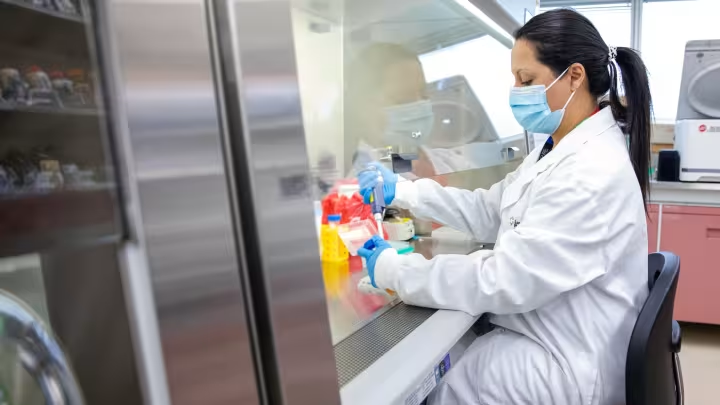
Dr. Rayjean Hung
Head, Prosserman Centre for Population Health Research
Associate Director, Population Health Data Science
Lunenfeld-Tanenbaum Research Institute
Integrative molecular epidemiology of complex diseases
Our research focuses on understanding how individual molecular profiles contribute to the development and progression of complex diseases.
Through integrative analysis of multi-dimensional data, we aim to identify key factors, such as health history and genetics, that influence disease risk, prevention strategies and early detection—and to translate these discoveries into strategies that improve population health.
We have conducted several large, multi-centre studies on cancers of the lung, head and neck, pancreas, and in children, with the overarching goal of reducing cancer mortality through earlier diagnosis and improved patient management. Our group leads projects using large-scale population biobank data and collaborates with international research consortia in Europe, North America and Asia.
Beyond cancer research, we also investigate how factors during pregnancy and early childhood shape health outcomes. We study environmental exposure and family health history to understand risk factors that can be passed from one generation to the next. To do this we use large birth studies and research involving parents and children together. We co-lead the Ontario Birth Study (OBS) and the Healthy Life Trajectories Initiative (HeLTI)–South Africa, which examine how early-life environments influence lifelong health and development.

Email: [email protected]

60 Murray Street
Toronto, M5T 3L9

Website: Hung Lab
Publications: PubMed
Google Scholar: Rayjean Hung
ORCID: 0000-0002-4486-7496
U of T Discover Research: Rayjean Hung
LinkedIn: Rayjean Hung
- 2026–2030; Canadian Representative, Scientific Council, International Agency for Research on Cancer, World Health Organization
- 2024–present; Canadian Representative, G7 Cancer Working Group – Prevention and Early Detection
- 2023–present; Full Member, Institute of Medical Science, University of Toronto
- 2022–present; Research Committee, HeLTI International Consortium
- 2021–present; Toronto Academic Health Science Network (TAHSN) Representative, Implementation Committee, Data Science Institute, Canada
- 2020–present; Full Professor, Division of Epidemiology, Dalla Lana School of Public Health, University of Toronto, Toronto
- 2014–present; Senior Investigator, Lunenfeld-Tanenbaum Research Institute, Sinai Health, Toronto
- 2016–present; Steering Committee, Ontario Birth Study, Canada
- 2012–present; Epidemiology Committee, Children’s Oncology Group, US and Canada
- 2010–present; Steering Committee and Admission Committee, Strategic Training for Advanced Genetic Epidemiology (STAGE) program, University of Toronto, Toronto
- 2005–present; Lead Scientific Coordinator, International Lung Cancer Consortium
- Visiting Scientist, International Agency for Research on Cancer, World Health Organization; 2005–2007
- Research Scientist, School of Public Health, University of California at Berkeley; 2005–2007
- Postdoctoral Special Training Awardee, International Agency for Research on Cancer, World Health Organization; 2004–2005
- PhD, (Genomic) Epidemiology, University of California at Los Angeles, LA, USA; 2000–2004
- MSc, (Molecular) Epidemiology, University of California at Los Angeles, LA, USA; 1998–2000
- BVM, National Taiwan University, Taipei, Taiwan; 1993–1998
- 2025 – Fellow, Canadian Academy of Health Sciences Canada
- 2018–2032 – Canada Research Chair in Integrative Molecular Epidemiology, Canadian Institutes of Health Research
- 2015 – Llyod S.D. Fogler Award for Research Excellence, Sinai Health, Canada
- 2011 – Early Researcher Award, Ontario Ministry of Research and Innovation
- 2008–2013 – Research Chair in Population Studies, Cancer Care Ontario
Risk prediction and early detection of fatal cancers
Lung and pancreatic cancers are two of the most fatal cancers. We are conducting international studies to identify blood-based biomarkers that can help to detect cancer early. This liquid biopsy approach is suitable screening for a targeted population before clinical symptoms. We are integrating epidemiological, molecular and clinical data, and use machine learning approaches to build and validate comprehensive risk prediction models.
Specifically for lung cancer, we are assessing the malignancy potentials of pulmonary nodule detected in the low-dose computed tomography. Our goal is to improve the survival of these fatal tumours and reduce mortality. These projects are funded by the Canadian Cancer Society Research Institute and the Canadian Institute of Health Research.
Prevention of Adiposity-related Cancers via Biology and Evidence Triangulation (PROBE) study
Adiposity-related metabolic issues are known to increase risk of at least 13 types of cancers, and will become a leading cancer cause worldwide with increasing prevalence. However, anthropometric measures such as BMI do not fully capture poor metabolic health. In this project, we will study whether glucagon-like peptide 1(GLP-1) medicines can be repurposed for cancer prevention through mechanism independent of weight loss, and identify optimized intervention strategies to prevent adiposity-related cancers based on individual’s metabolic profile.
Improving Detection of Early Lung Cancer in a Diverse Population (IDEAL) study
To improve early detection of lung cancer in diverse population, Dr. Hung and her collaborators in BC Cancer, University Health Network and Laval University launched a new cross-province program focused on incidental pulmonary nodules. The IDEAL study is funded by the Canadian Cancer Society Research Institute and will leverage artificial intelligence to identify individuals at high risk of lung cancer based on their molecular profiles. For more information, please see the IDEAL website.
International Lung Cancer Consortium (ILCCO)
The International Lung Cancer Consortium (ILCCO) is an international group of lung cancer researchers, established in 2004 with the aim of sharing comparable data from ongoing lung cancer case-control and cohort studies. Our group serves as the ILCCO Data Repository and has harmonized data from over 90 lung cancer studies and a total of 1.2 million study participants, including over 80,000 lung cancer patients.
These studies are from different geographical areas and ethnicities and represent one of the largest epidemiological databases for lung cancer to date. The overall objectives are to achieve greater power, especially for subgroup analyses, reduce duplication of research effort, replicate novel findings, and afford substantial cost savings through large collaborative efforts. Please see ILCCO website.
Childhood cancer studies: Wilms tumour and childhood brain tumours
We are conducting a North American Wilms Tumor Study based on case-control parent trio design. The main objectives are to understand the effects of parental and neonatal factors on the risk of Wilms tumor including parental lifestyle, medical history, genetic make-up and molecular profiles. In addition, we are investigating the etiology of childhood brain tumors based on the Childhood Brain Tumor Epidemiology in Ontario (CBREO) Study, including transgenerational exposures from the parents, children’s early life determinants and their molecular profiles.
Developmental origin of health and complex diseases
Our group is actively working with the Ontario Birth Study (OBS), a research platform to facilitate the investigation of early life events and their relationships with health and complex disease later in life. We are conducting longitudinal follow-up for children born in OBS at multiple time points and assessing their neurodevelopment. For more information about OBS, please visit the study website.
As part of a multi-national intervention trial, our group is working on the Healthy Trajectory Initiative (HeLTI) - South Africa. For more information about HeLTI, please visit the program website.
Notable publications
Chest, 2026
Journal of the National Cancer Institute, 2023
Nature Communications, 2020
Nature, 2018
Nature Genetics, 2017
Join our team
Visit our job board to see research positions.