


Dr. Rod Bremner
Lunenfeld-Tanenbaum Research Institute
Developing new strategies against cancer and blindness
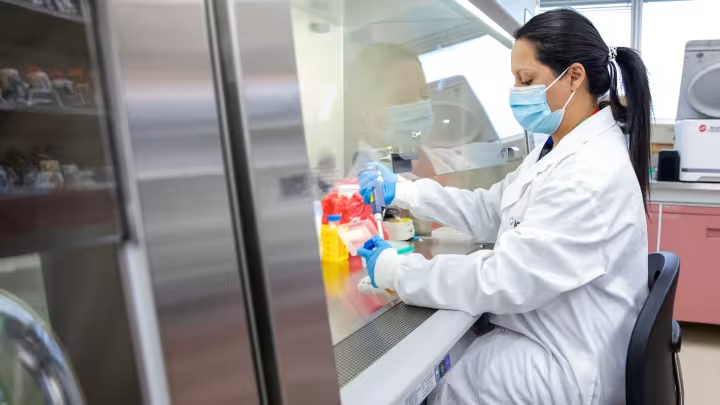
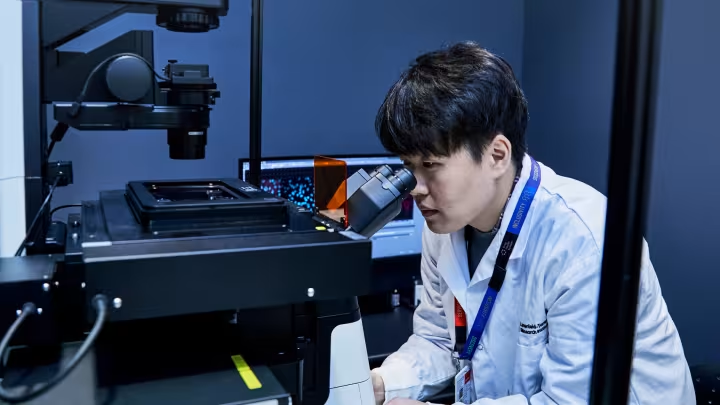
We use advanced genetic and molecular tools, along with lab and animal models, to understand how cancer starts, grows and responds to treatment. We also study how key cancer genes influence the development, damage and repair of the retina.
Individual cancer cells have large differences in their molecular makeup which makes treatment challenging. However, common patterns can reveal vulnerabilities shared across cancers. We grouped all cancers into just two classes (YAPoff and YAPon) based on whether the YAP gene is active or inactive and whether it promotes or suppresses cancer (Cancer Cell 2021). We’re now studying how YAP suppresses YAPoff cancers, several of which are highly lethal, and how cancers switch between classes to evade therapy.
“Oncogenic” mutations cause cancer, but remarkably they are harmless in most cell types. Research focuses on tumors, but why are so many cells cancer-resistant? We exposed a hallmark that distinguishes cancer-prone vs. resistant cell types: resistant mutated cells divide more slowly than cancer-prone mutated cells (Nature, 2025). This is the most prevalent cancer defense strategy, yet we understand little about how it works. We are working on deducing the mechanism.
Our group expanded insight into retinal development and photoreceptor cell survival (e.g. Nature 2009, PNAS 2013, Dev. Cell 2020). Applying cancer expertise, we unlocked a mechanism for generating cone photoreceptors, nerve cells responsible for colour vision, which may help expose strategies to regenerate cones to treat blindness.
Overall, our work simplified cancer, exposed a hallmark of cancer susceptibility, and revealed strategies that may permit nerve cell regeneration. These insights provide opportunities for therapeutic intervention with broad clinical relevance.

Email: [email protected]

600 University Avenue
Toronto, M5G 1X5

Publications: PubMed
Google Scholar: Rod Bremner
ORCID: 0000-0001-9184-7212
- 2012–present; Senior Investigator, Freiberg Cancer Research Chair, Lunenfeld-Tanenbaum Research Institute, Sinai Health, Toronto
- 2007–present; Professor, Department of Ophthalmology & Vision Sciences, University of Toronto, Toronto
- 2007–present; Professor, Department of Laboratory Medicine and Pathobiology, University of Toronto, Toronto
Former appointments
- 2006–2013; Head, Genetics and Development Division, Toronto Western Hospital, UHN, Toronto
- 2005–2006; Interim Head, Cell and Molecular Division, Toronto Western Hospital, UHN, Toronto
- 2001–2013; Senior Scientist, Toronto Western Research Institute, UHN, Toronto
- 2001–2007; Associate Professor, University of Toronto, Toronto
- 1994–2001; Scientist and Assistant Professor, University of Toronto, Toronto
- Postdoctoral fellowship, The Hospital for Sick Children (SickKids), Toronto, Canada; 1990–1994
- PhD in Molecular Genetics, Beatson Institute of Cancer Research, University of Glasgow, Scotland; 1985–1990
- BSc in Biochemistry, University of Aberdeen, Scotland; 1981–1985
- 2025 – Honorary degree (Docteur Honoris Causa), Paul Sabatier University, France
- 2018–present – Freiberg Cancer Research Chair, Sinai Health
- 2014 – Donna Green Award for Restoring Sight, Foundation Fighting Blindness
What distinguishes cancer-prone and cancer-resistant cell types?
“Oncogenic” mutations drive cancer but susceptibility to any specific oncogene activation or tumour suppressor loss is cell type specific, and any one oncogenic mutation only transforms a few lineages. For example, Kras activation transforms lung alveolar type 2 cells but not lung neuroendocrine cells, whereas the reverse is true for Rb/p53 loss.
Engineered mice carrying “oncogenic” mutations in every tissue and lineage develop very few types of cancer, and human tissues are peppered with such mutations that never cause cancer. What distinguishes cancer-prone cell types? We showed across several tissues and different mutation types that while oncogenic mutations can stimulate abnormal division in many lineages, the ones that are cancer-prone have the shortest cell cycle (Nature, 2025).
Modestly expanding cell cycle length in cancer-prone lineage could prevent transformation, despite having no effect on many other cancer hallmarks. Thus, while cancer has multiple hallmarks, many hallmarks does not mean cancer. These data expose cell cycle length as a critical vulnerability. Moreover, it appears that the most studied mechanisms of cancer resistance (senescence, cell death, immune clearance) are not the most common; rather, trillions of mutated cells can resist cancer if their cell cycle is long enough. Our lab is now applying multiple models and a variety of single cell omics to deduce the molecular mechanism underlying transformation capacity.
How does YAP suppress YAPoff cancers?
Heterogeneity and cancer cell plasticity underpin drug resistance. Precision medicine aims to deduce and attack each of the many features that can cause drug resistance, but it’s a complex approach requiring extensive information about clones and subclones in a tumour. Overarching rules can expose broadly relevant vulnerabilities.
We simplified all cancers into binary classes (YAPoff and YAPon) based on the opposite expression and opposite pro- or anti-cancer activity of YAP (Cancer Cell 2021). YAPoff cancer include all the blood cancers (e.g. leukemia, lymphoma) and neuroendocrine cancers (e.g. small cell lung cancer) as well as some neural cancers (e.g. retinoblastoma).
The two classes exhibit striking differences in adhesion (YAPoff cancers float in vitro, YAPon cancers stick), and genetic or drug vulnerabilities. YAPoff cancers hate YAP, while YAPon cancers can’t do without it. This contrast reflects distinct gene targets: YAP drives cell cycle genes in YAPon cancers but forced YAP expression in YAPoff cancers induces adhesion/extra cellular matrix genes that mediate growth arrest. In both cases YAP uses TEAD DNA binding proteins to target genes.
We are studying how YAP suppresses YAPoff cancers, several of which are highly lethal, with the goal of exposing new strategies to prevent and treat tumours. Moreover, YAPoff and YAPon cancers can switch classes to evade therapy, so we are also studying how this process works with the goal of uncovering ways to block this conversion and improve cancer therapeutic responses.
Photoreceptor degeneration and regeneration
We’ve had a long-standing interest in the childhood eye cancer retinoblastoma. That work sparked our interest in retinal development and other retinal diseases, such as retinitis pigmentosa (RP) in which photoreceptors gradually die leading to blindness. Oncogenes and tumour suppressors play key roles in controlling tissue growth, cell type specification, and cell survival. We’ve elucidated multiple roles for proteins like RB and its partners such as E2F as well as other key regulators in retinal development and neuronal survival (e.g. Nature 2009, PNAS 2013, Dev. Cell 2020).
In RP, blindness starts with loss of rod photoreceptors which are used for night vision, which has a knock-on effect on cones which are essential for colour and day vision. We’re applying a suite of omics tools to elucidate how cones develop with the goal of using these insights to regenerate cones in an adult mammalian retina.
We’re also studying how photoreceptor death occurs with the goal of identifying therapeutic targets to preserve these vital neurons. This work is supported by our expertise in cell cycle and cell fate that underpins our cancer work.
We are always looking for motivated researchers to join our team.
Postdocs
Our research group is always interested in recruiting highly motivated postdoctoral fellows with a strong publication record in omics. Please forward your CV, references and research interests to Rod Bremner ([email protected]).
Graduate students
Our research group is part of the Department of Laboratory Medicine and Pathobiology (LMP) in the Faculty of Medicine at University of Toronto. Students need to apply to LMP to gain acceptance. If you are interested in joining our lab to do a Masters or PhD you can contact Rod Bremner ([email protected]).
Summer students
Summer students are often selected from successful applicants to the Research Training Center (RTC) at the Lunenfeld-Tanenbaum Research Institute. Applications are available online and need to be filled by February 28th of each year. You can also contact Rod Bremner ([email protected]) directly.
Notable publications
Cell Reports, 2023
Cancer Cell, 2021
Oncogene, 2020
Developmental Cell, 2020
Join our team
Visit our job board to see research positions.