



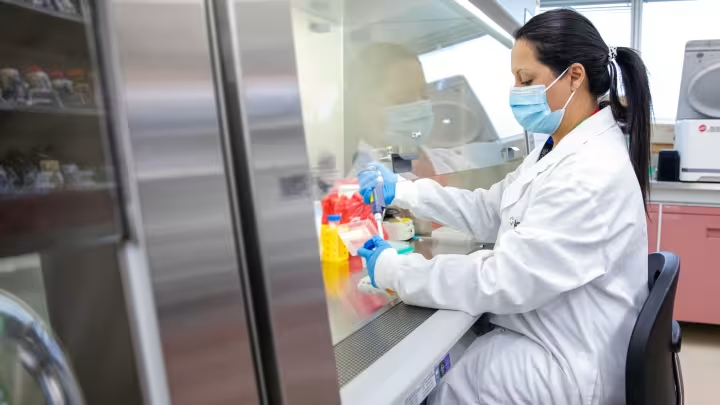
Dr. Amish Jain
Clinical Research Director, Neonatal Intensive Care Unit
Department of Paediatrics (Neonatology), Mount Sinai Hospital
Improving heart and lung outcomes form extremely preterm babies
Our research focus is on blood flow and breathing in newborns with the aim to improve the health of critically ill, extremely preterm babies.
Babies born extremely premature commonly face serious challenges with heart and lung function, directly impacting their potential of survival, and short- and long-term health. Our research team utilizes advanced non-invasive bedside ultrasound tools to help advance our knowledge of heart function and circulatory physiology in extremely premature babies, gain mechanistic insights, discover new limits when treatments may be warranted and conduct studies to develop newer treatment methods. The real-time information gained by our methods has helped clinicians to achieve precision in clinical care and provide individualized management. This led to the creation of a clinical consult service in our department, that has reduced mortality and the incidence of brain injury among critically sick preterm babies.
Further, we have developed innovative treatment options for common circulatory and respiratory complications faced by premature babies. We are currently investigating the clinical impact of these strategies in multi-centre federally funded studies.
Our overall goal is to improve the current standard of acute care in neonatal intensive care units, reduce the burden of death and short- and long-term heart, lung and brain complications for this vulnerable patient population. By translating our discoveries into better treatments, our research team aspires to give extreme preterm babies the best chance for a healthier future.

Email: [email protected]

Room 19-231, 600 University Avenue
Toronto, M5G 1X5

Publications: PubMed
ORCID: 0000-0002-1413-2966
Physician profile: Amish Jain
X: @Dr_AmishJain
- 2025–present; Clinical Research Director, Department of Paediatrics, Mount Sinai Hospital, Sinai Health, Toronto
- 2023–present; Professor, Department of Paediatrics, Faculty of Medicine, University of Toronto, Toronto
- 2020–present; Co-Chair, Neonatal Hemodynamics and Cardiovascular group, Evidence-based Practice for Improving Quality (EPIQ)
- 2019–present; Founder and Co-Chair, Neonatal Hemodynamics Research Centre
- 2015–present; Clinician Scientist, Lunenfeld-Tanenbaum Research Institute, Sinai Health, Toronto
- 2011–present; Director, Targeted Neonatal Echocardiography (TNE) Program, Department of Paediatrics, Mount Sinai Hospital, Sinai Health, Toronto
Former appointments
- 2021–2023; Section Lead, International Guideline Panel for updating American Society of Echocardiography (ASE) guideline for the use of Targeted Neonatal Echocardiography (TNE) in NICUs
- 2018–2023; Associate Professor, Department of Paediatrics, Faculty of Medicine, University of Toronto, Toronto
- 2011–2017; Assistant Professor, Department of Paediatrics, Faculty of Medicine, University of Toronto, Toronto
- Clinician Scientist Trainee, Clinician Scientist Training Program, Hospital for Sick Children (SickKids), Toronto; 2013–2014
- Clinician Scientist Development Program, Division of Neonatology, University of Toronto, Toronto; 2011–2014
- PhD in Physiology, Cardiovascular Sciences Collaborative Program, University of Toronto, Toronto; 2011–2017
- Neonatal-Perinatal Fellowship, University of Toronto, Toronto; 2008–2011
- Registrar training (Fellow) in Neonatology, St. Mary’s Hospital, Imperial College Healthcare NHS Trust, London, UK; 2007–2008
- MRCPCH, Royal College of Paediatrics and Child Health, UK; 2006
- Paediatric Resident Training, UK; 2004–2007
- MBBS, Nagpur University, Maharashtra, India; 1996–2001
- 2022 – Elected for active membership with the American Pediatric Society (APS)
- 2022 – Awarded Canadian National Perinatal Research Meeting’s (CNPRM) Early Career Research (ECR) invited lecture
- 2021 – Fellow of the American Society of Echocardiography (FASE)
- 2019 – Young Investigator Award, Canadian Paediatric Society (CPS)
- 2017 – Jack Kraicer Award for Research Excellence during Doctoral Studies, Department of Physiology, University of Toronto, Toronto
- 2014 – Bigelow Book Prize, Cardiovascular Sciences Collaborative Program, Faculty of Medicine, University of Toronto, Toronto
- 2013 – SickKids Clinician-Scientist Training Program (CSTP) Doctoral Award
- 2012 & 2016 – Award for Teaching Excellence, Neonatal-Perinatal Medicine Training Program, Department of Paediatrics, University of Toronto, Toronto
Led by Dr. Amish Jain, the Neonatal Hemodynamics & Respiratory Research Program within the Department of Paediatrics at Mount Sinai Hospital is dedicated to improving the health of critically sick extremely preterm infants.
Co-administration of acetaminophen with ibuprofen to improve duct-related outcomes in extremely premature infants – The ACEDUCT trial
Patent ductus arteriosus (PDA) is the most common heart condition in babies born early, where a blood vessel that should close after birth stays open, making it harder for the heart and lungs to work efficiently. PDA is associated with many complications like higher mortality, bleeding in the brain, longer ventilator needs and chronic lung disease, growth failure, intestinal problems and long-term adverse developmental effects.
The current standard treatment for PDA is to give a single medication, either ibuprofen (Advil) or acetaminophen (Tylenol), for three days. However, this approach does not always work; in about 60 per cent of infants the blood vessel remains open despite treatment resulting in the need for further treatments and prolonged disease exposure. This treatment failure is associated with an increase in clinical complications. As acetaminophen and ibuprofen are established synergistic agents for reducing pain and fever in children and adults, we are examining the impact and safety of their co-administration as a more effective way to treat PDA in premature babies.
The ACEDUCT trial, funded by the Canadian Institute of Health Research (CIHR) in the year 2022, is the first large study testing the clinical effectiveness of the combined use of acetaminophen and ibuprofen versus ibuprofen alone (current standard) for treatment of PDA in premature neonates born at less than 27 weeks of gestation. This planned four-year trial is running in eight centres [five in Canada, one in Ireland and two in Australia, with the objective of reducing the rates of severe prematurity-related chronic lung disease or death by reducing first PDA treatment failure.
Co-administration of acetaminophen with ibuprofen to improve duct-related outcomes in extremely premature infants: 18-30 months neurodevelopmental outcomes (ACEDUCT-2)
One of the major knowledge gaps in the field of tertiary neonatology is the absence of data on long-term neurodevelopmental outcomes following patent ductus arteriosus (PDA) treatment in extremely premature infants, causing uncertainty in routine clinical care. Funded by the CIHR in the year 2025, ACEDUCT-2 is being conducted to ensure standardized neurodevelopmental assessments of prematurely born children that are participating in the ongoing ACEDUCT trial for testing the new PDA treatment strategy.
All children will be systematically assessed between 18 and 30-months corrected age to investigate the long-term safety and effects of our new combination therapy for PDA. We will evaluate motor, language, cognitive development and neurosensory function, and examine the impact of combination treatment with acetaminophen and ibuprofen on post-discharge respiratory morbidities, measurements of growth and body size and social communication functioning during early childhood.
Dopamine vs. norepinephrine for hypotension in very preterm infants with late-onset sepsis: an international comparative effectiveness research project
Very premature babies, born at or before 32 weeks of pregnancy, are at high risk of infections during hospital stay. Late-onset sepsis (LOS), an infection occurring after the first 48 hours, can cause dangerously low blood pressure (hypotension) requiring supportive treatments (vasopressor medications) in ~30 per cent of patients. While these patients are at the highest risk of death from LOS (mortality rate ~40 per cent), the specific vasopressor drug that provides best survival benefit is unknown, resulting in wide variability in practice among clinicians in Canada and beyond.
To address this gap, our team is conducting an international study comparing the standardized use of dopamine versus norepinephrine, two most used vasopressor drugs to support blood pressure during LOS in very preterm infants. 16 neonatal intensive care units in Canada, three in the United States, two in the United Kingdom and one each in Israel, Ireland and Spain are participating in this study, funded by the CIHR. We plan to collect data on 550 participants across study sites between the years 2023 and 2027, to examine which of these two agents provide best stability and survival benefit in premature neonates critically sick from LOS during hospital stay.
By using real-world data from existing practices, this research is expected to guide clinicians in choosing the optimal treatment for low blood pressure in very premature infants with LOS that provides best possible clinical outcome.
Link to pilot study: Nissimov S, Joye S, Kharrat A, Zhu F, Ripstein G, Maczynski M, Choudhury J, Jasani B, Deshpande P, Ye XY, Weisz DE, Jain A. Dopamine or norepinephrine for sepsis-related hypotension in preterm infants: a retrospective cohort study. Eur J Pediatr., 2022.
A cluster crossover randomized controlled trial of manual T-piece versus ventilator positive pressure ventilation during resuscitation of extremely premature neonates: The MVP Trial
Many extremely premature infants, born before 28 weeks of pregnancy, need immediate help with breathing after birth. Positive pressure ventilation (PPV) provided by the resuscitation team helps to open their lungs, improve oxygen delivery and establish spontaneous breathing, avoiding the need for aggressive ventilation methods associated with adverse outcomes. Manual use of T-piece resuscitator (TPR) is currently the most common method to deliver PPV; however, it has major clinical limitations related to operator variability and needs to use a full-face mask. Improving the PPV method is extremely important as it can minimize the need for invasive procedures, such as intubation and invasive mechanical intubation that pose an increased risk of complications and death for these fragile infants.
To address this common clinical problem, we developed a nasal-mask ventilator-delivered (V-PPV) method of providing PPV in extremely preterm neonates at birth. This method may avoid many of the limitations of TPR and allows more automated and precise control of delivered breathing support. Preliminary data from our single-centre study showed that V-PPV is feasible and may be more effective than the TPR, indicating a 28 per cent reduction in the need for intubation and emergent use of invasive mechanical ventilation.
Based on our experience, we were able to obtain funding from the CIHR to undertake a definitive large-scale study to compare the clinical outcomes of extremely premature infants receiving manual TPR versus V-PPV for provision of breathing support during the immediate post-birth stabilization. The primary goal is to evaluate the impact of V-PPV on major health complications or death. By refining how respiratory support is provided in the critical first moments of life, this research has the potential to improve survival and long-term health for preterm infants.
Link to pilot study: Akhtar N, Hemani A, Jasani B, Lindsay B, Morgan B, Jain A, Baczynski M. Nasal mask ventilator-delivered versus face mask T-piece resuscitator positive pressure ventilation during resuscitation of preterm neonates: a cohort study. Arch Dis Child Fetal Neonatal Ed., 2025.
We are always open to hearing from motivated researchers interested in joining our team.
Fellowship
We accept applications annually, in July, for University of Toronto’s Neonatal Hemodynamics and Targeted Neonatal Echocardiography (NHTNE) Subspecialty Fellowship training program. The NHTNE program is a centre of excellence that unites related academic, clinical and educational activities from three tertiary centres (Mount Sinai Hospital, Sunnybrook Health Sciences Centre and the Hospital for Sick Children) under one collaborative umbrella. In addition to clinical training, an expectation of the fellowship is to complete at least 1 primary research project in the field of neonatal cardiovascular medicine.
Summer students
Summer students should contact the Neonatal Hemodynamics Research Program Manager Laura Thomas ([email protected]) directly to learn about current/upcoming opportunities.
Notable publications
JAMA Network Open, 2025
BMJ Journals, 2025
BMJ Journals, 2025
The Journal of Pediatrics, 2025
European Journal of Pediatrics, 2022
Join our team
Visit our job board to see research positions.