






How Sinai Health is building equity into care and culture
How we treat our people has an impact on how we care for our patients. Equity in the workplace and equity in care are not parallel priorities at Sinai Health — they’re two halves of a whole.
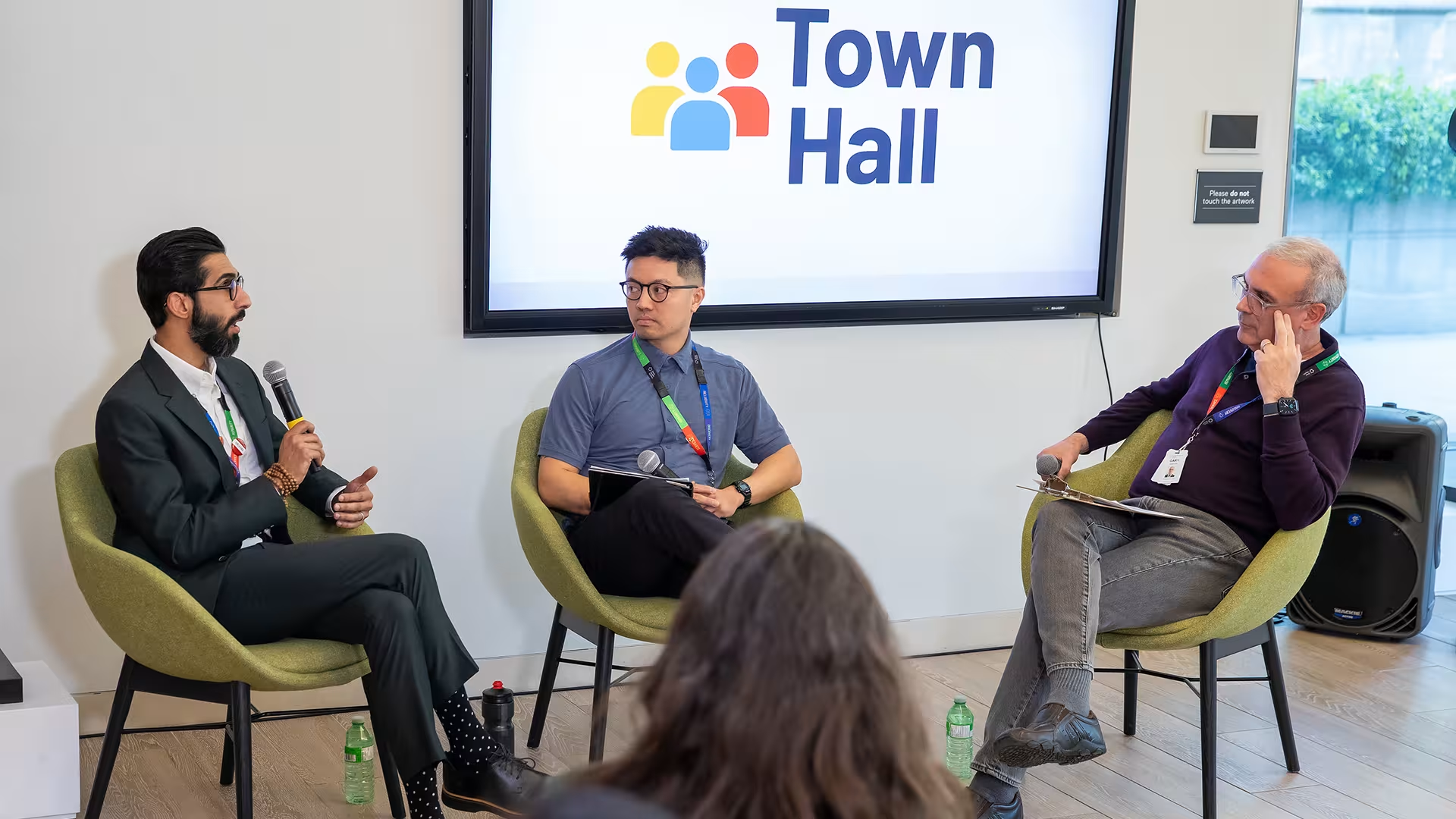
During a recent Town Hall, Robin Waley, Director, People Equity and Respectful Workplace, and Michael Palomo, Director, Health Equity and Patient Relations, joined Dr. Gary Newton, President and CEO, to explore how People Equity and Health Equity are being woven into Sinai Health’s everyday practices, decisions and culture.
Q: What do People Equity and Health Equity mean at Sinai Health? How are they connected?
Robin Waley: People Equity is the workplace side of our broader equity commitment at Sinai Health. The term is intentional and connects directly to our People Plan by mirroring the language we use for Health Equity.
The two are inseparable. We can’t provide equitable care to patients if the people providing that care are not experiencing equity and inclusion themselves. When our people feel included, that translates directly into how we treat patients and each other.
Michael Palomo: Health Equity is about creating the conditions where all patients can reach their full health potential and receive care that is fair, appropriate and responsive to their needs, regardless of who they are, where they live or what resources they have access to.
The connection between Health Equity and People Equity is very practical. When our people feel they belong and feel psychologically safe in the workplace, they’re more likely to speak up about patient safety concerns. They can work collaboratively with their peers and deliver better care. Equitable workplaces help foster the conditions that enable more equitable care.
Q: What’s the difference between “equity” and “equality”?
MP: I think the difference is between fairness and sameness. Equality means treating everyone the same, while equity means recognizing that people have different needs, circumstances and barriers — and responding in ways that help everyone achieve the same opportunity for health and well-being.
At Sinai Health, we serve a diverse patient population. Equity is about meeting people where they are, understanding their unique experiences and caring for them as whole people. It ensures that every patient has the support they need to access the best possible care and outcomes.
Q: The People Equity Strategy focuses on system change. What does that mean in practice?
RW: System change means analyzing and addressing the policies, practices and norms that create barriers for our people in the workplace. We are embedding equity into the structures that shape everyday experiences. This touches everything from how we hire and train to how we evaluate performance.
One way we’ve embedded equity is by adding an option to report harassment and discrimination directly through our internal safety-reporting system. We also now review every report through an equity lens, even when it is not labelled as a harassment or discrimination issue. And we’re tracking outcomes over time so we can identify patterns and inform strategic decision-making.
We have also connected People Equity education to our Quality Improvement Plan, bringing the work of both teams together around a shared commitment to culturally safer care.
The Toronto Academic Health Sciences Network (TAHSN) recently launched new anti-racism toolkits to support equity education across Ontario’s academic health science centres, and our work reflects this shared, system-wide priority.
Q: How is Health Equity embedded in the Quality Improvement Plan? What does that mean for patient outcomes?
MP: When we renewed our Quality Aims for 2025 to 2028, we made a deliberate decision to add equity as a distinct area of focus. Our framework is called STEEPed in Quality, with its acronym standing for Safe, Timely, Effective, Equitable and Person-Centred care.
In practice, that means taking a closer look at who is benefiting from our care, identifying where gaps exist and for whom, and using that information to guide improvement work. Equity is now a formal, measurable dimension of care quality at Sinai Health, not aspirational language.
Q: Is there work in this space you’d like to highlight?
RW: In January, we held our first People Equity Dialogues, open sessions where any of our people could share their perspectives on our strategic equity work. This year, the focus was equity education, and what we heard directly shaped what we built next. Out of those conversations, we are developing a new process for our teams to access facilitated, in-person equity education. These should launch in the coming months.
I should add that People Equity does not belong to one team. It belongs to everyone at Sinai Health — every manager who creates space for honest feedback, every colleague who supports others, every leader who asks whether the decision they are about to make is equitable.
MP: I’d like to highlight the co-design of our new Providing Access for People with Disabilities Policy, which went live in January 2026. We engaged more than 80 individuals — including patients, families, caregivers with lived experience of disability, accessibility advocates, staff, physicians, leaders and community partners — because we believed the people most affected by the policy should help shape it.
What emerged was more than a policy refresh. It was a shared vision for a more accessible and inclusive Sinai Health. Together, we broadened our focus beyond physical barriers to consider the systems, attitudes, communications and information environments that can affect a person’s experience of care and work. We also strengthened the practical guidance that helps our people translate these principles into everyday action.
This work is part of a broader journey to make accessibility a cornerstone of how we deliver care and create belonging. As we refresh accessibility training across Sinai Health this year, we are reinforcing the idea that accessibility, inclusion, patient experience, safety and equity are deeply interconnected and essential to exceptional care.
Related news and stories
View all News and Stories


