


From operating room to recycling stream: Peri-Operative Services team reduces waste for Earth Week
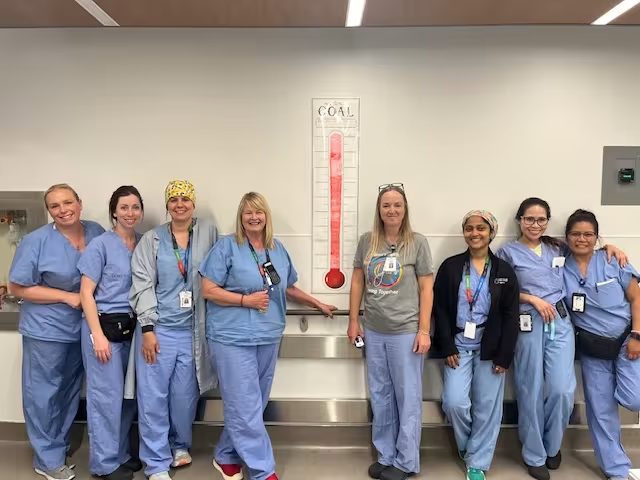
As Sinai Health marks Earth Week, a grassroots initiative led by staff in Peri-operative Services is showing how small changes can make a big environmental impact.
Launched in April 2025, the polyvinyl chloride (PVC) recycling project began as a quality improvement initiative driven by a shared commitment to sustainability. Today, it has already diverted more than 3, 400 pounds of waste from landfill – an early milestone that reflects both staff engagement and the potential for scalable change.
“It’s amazing that such a small project can be so impactful… we surpassed our goal within the first two weeks,” said Katie Cameron, Registered Nurse in Peri-operative Services.
The idea originated through a combination of clinical interest and ON-SQIN (Ontario Surgical Quality Improvement Network) project. Katie, a master’s student focused on sustainability and health equity, partnered with clinical team members to turn an existing concept into a practical, everyday solution. Together, they developed a process that fits seamlessly into their workflows while maintaining safety and infection prevention standards.
In practice, the program is simple. In the post-anesthesia care unit (PACU), commonly used items such as oxygen masks, IV bags and nasal prongs are collected in designated recycling hampers instead of being discarded as general waste. Staff sort materials at the point of care, and full bins are transferred to larger collection totes before being processed by a specialized recycling partner.
What has made the initiative successful is not just the process, but the people behind it. As part of her master’s program, Katie conducted a staff engagement study that gauged health-care staff’s concern regarding climate change, as well as the impact on staff after being involved in an environmentally sustainable project. Survey results showed that out of 105 participants, staff in the peri-operative department, 77 per cent of respondents said concern about the environment and climate change affects their mental health. Further, over half of staff stated that they felt guilty walking into the hospital knowing the large amount of waste it produces.
When Katie surveyed 30 staff members that participated in the PVC recycling initiative, 93 per cent of participants stated that participating in this sustainability initiative increased their job satisfaction, made them prouder of the work they did and contributed to their overall well-being.
That awareness translated into action on the ground, with nurses and service assistants playing a critical role in ensuring materials are sorted correctly and the program runs smoothly. Reeba Philip, Operations Manager of Peri-operative services, oversaw regular audits as well as staff education to ensure that common challenges such as improper waste sorting could be addressed in real-time.
“The staff were really excited,” said Cameron. “They were the ones making sure the right things were going into the bins every day.”
The project has also helped build awareness of sustainability efforts across the organization, an important step as Sinai Health continues to expand its environmental initiatives through the development and implementation of Sinai Health’s Sustainability Strategy. Leaders say storytelling and communication will play a key role in scaling similar efforts across other units.
While expansion requires careful planning to maintain quality and safety standards, interest is already growing. Teams across the hospital are exploring how similar approaches could be adapted to their own areas.
As part of a broader commitment to environmental responsibility, Sinai Health is also contributing to system-wide efforts highlighted in the 2025 Toronto Academic Health Science Network’s Climate and Sustainability Report.
For the team behind the PVC recycling project, the message is clear: meaningful change does not always start with sweeping policy shifts. Sometimes, it starts with a single bin – and a group of people willing to use it differently.
Related news and stories
View all News and Stories


